
LIPOPROTEIN METABOLISM-I
Plasma lipids consist of triacylglycerols (16%), phospholipids (30%), cholesterol (14%) and cholesteryl esters (36%), and a much smaller fraction of unesterified long-chain fatty acids (4%). This latter fraction, the free fatty acids (FAA), is metabolically the most active of the plasma lipids.
Chylomicron Metabolism
- nascent chylomicron assemble in the intestine and transported by lymphatics
- mature chylomicronby receiving apo C-II and apo E from HDL, HDL acts as the repository of apo C and apo E.
-
Apo C-II activates Lipoprotein Lipase, Lipoprotein Lipase hydrolyses TAG in mature chylomicron to fatty acid and glycerol, to form
remnant Chylomicron.
-
IT is taken up in the liver by receptor mediated endocytosis, These remnants containing apo-B-48 and apo-E are taken up by hepatic cells by receptor mediated endocytosis.
Apo-E binds the hepatic receptors
-
Uptake is mediatedby apo E via two apo E dependent recptors,LDL receptor and LDL receptor related protein-I (LRP-I).

-
These are the transport form of dietary triglycerides from intestines to the adipose tissue for storage; and to muscle or heart for their energy
needs
VERY LOW DENSITY LIPOPROTEINS(VLDL) METABOLISM
- The half-life of VLDL in serum is only 1 to 3 hours, apo-C-II activates LpL when they reach peripheral tissues.
- Approximately 30% of LDL is degraded in extrahepatic tissues and70 % in the liver.
- Remnant is now designated as IDL (intermediate density lipoprotein) and contains less of TAG and more of cholesterol.
- IDL further loses triglyceride, so as to be converted to LDL (low density lipoprotein) caleed as lipoprotein cascade pathway.
- VLDL carries triglycerides (endogenous triglycerides) from liver to peripheral tissues for energy needs.
- Cholesterol lowering effect of PUFA and MUFA is thought to be due to upregulation of LDL-receptor.
LOW DENSITY LIPOPROTEINS (LDL)
- LDL is taken up by peripheral tissues by receptor mediated endocytosis.
-
LDL receptors are present on all cells but most abundant in hepatic cells. LDL receptors are located in specialised regions called clathrin-coated pits.
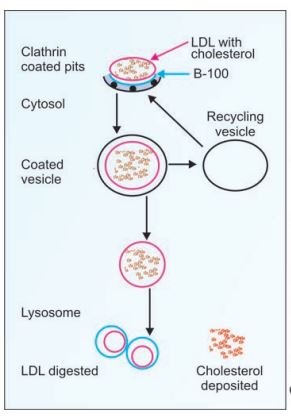
- apo B100 acts as the ligand for LDL receptors. LDL transports cholesterol from liver to the peripheral tissues.
- The influx of Cholesterol into the cell suppress the synthesis of LDL receptor by SREBP (sterol regulatory element-binding protein) pathway.
Exam Important
- Plasma lipids consist of triacylglycerols (16%), phospholipids (30%), cholesterol (14%) and cholesteryl esters (36%), and a much smaller fraction of unesterified long-chain fatty acids (4%). This latter fraction, the free fatty acids (FAA), is metabolically the most active of the plasma lipids.
- Chylomicrons are principal form in which dietary lipids (exogenous lipids) are carried from intestine to liver.
- VLDL are endogenous triglyceride from liver to peripheral tissue.
- Cholesterol lowering effect of PUFA and MUFA is thought to be due to upregulation of LDL-receptor.
- LDL is bad cholesterol, elevated serum concentration of LDL causes excessive deposition of cholesterol in peripheral tissues and enhance atherosclerosis; therefore, predisposes to MI.
- LDL is considered as a marker for cardiovascular disease. It is also called lethally dangerous lipoprotein” (LDL)
- Free cholesterol in the cells inhibits LDL receptors (down regulation) as a result further uptake of LDL cholesterol is inhibited. The intracellular cholesterol activates the intracellular enzyme acyl-CoA cholesterol acyl transferase (ACAT)
Don’t Forget to Solve all the previous Year Question asked on LIPOPROTEIN METABOLISM-I
Click Here to Start Quiz
Click Here to Start Quiz

