


RNA editing
RNA editing
- RNA editing is a process through which the nucleotide sequence specified in the genomic template is modified to produce a different nucleotide sequence in the transcript.
- Even after mRNA has been fully processed, it may undergo additional posttranscriptional modification in which a base in the mRNA is altered. This is known as RNA editing.
- There are two generic classes of RNA editing in nuclei, involving enzymatic deamination of either C-to-U or A-to-T nucleotides.
- Current estimate suggest that 0.01% of mRNA is edited in this fashion
- The best characterized example of C-to-U RNA editing is that of apolipoprotein B (apoB), which is mediated by a holoenzyme that contains a minimal core composed of an RNA-specific cytidine deaminase apobec-1, and its cofactor apobec-1 complementation factor (ACF).
- (apo) B—an essential protein component of chylomi-crons and very low density lipoproteins (VLDL).

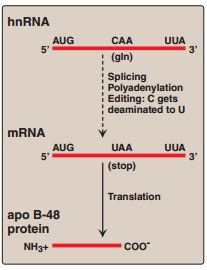
- the C residue in the codon (CAA) for glutamine is deaminated to U, changing the sense codon to a nonsense or stop codon (UAA).
- This results in a shorter protein (apo B-48, representing 48% of the message) being made in the intestine (and incorporated into chylomicrons) than is made in the liver (apo B-100, full-length, incorporated into VLDL)
- the linear relationship between the coding sequence in DNA, the mRNA sequence, and the protein sequence is altered.
- It is an exception to Central Dogma of molecular genetics.
- The single apoB gene is transcribed into an mRNA that directs the synthesis of a 512kDa proteiry apo 8100 with 4536 amino acid residues.
- A cytidine deaminase converts a CAA codon in the mRNA to UAA at a single specific site
- Other examples of RNA editing o Glutamate Receptor (Glutamine changed toArginine) Trypanosome mitochondrial DNA.
Exam Important
- Even after mRNA has been fully processed, it may undergo additional posttranscriptional modification in which a base in the mRNA is altered. This is known as RNA editing.
- There are two generic classes of RNA editing in nuclei, involving enzymatic deamination of either C-to-U or A-to-T nucleotides.
- Current estimate suggest that 0.01% of mRNA is edited in this fashion
- The best characterized example of C-to-U RNA editing is that of apolipoprotein B (apoB), which is mediated by a holoenzyme that contains a minimal core composed of an RNA-specific cytidine deaminase apobec-1, and its cofactor apobec-1 complementation factor (ACF)
- It is an exception to Central Dogma of molecular genetics.
- The single apoB gene is transcribed into an mRNA that directs the synthesis of a 512kDa proteiry apo 8100 with 4536 amino acid residues.
- A cytidine deaminase converts a CAA codon in the mRNA to UAA at a single specific site
- Other examples of RNA editing o Glutamate Receptor (Glutamine changed toArginine) Trypanosome mitochondrial DNA.
Don’t Forget to Solve all the previous Year Question asked on RNA editing

