
Question
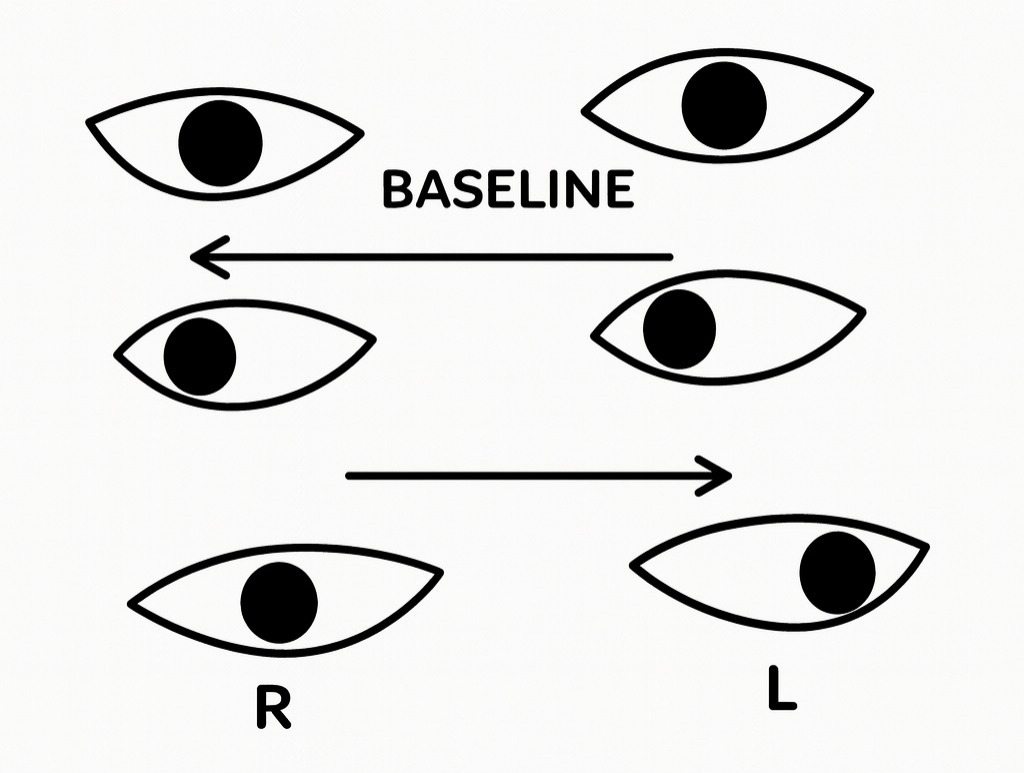
Which of the following is the diagnosis based on the given eye movement abnormality image?
| A. | Internuclear ophthalmoplegia |
| B. | 3rd nerve palsy |
| C. |
6th nerve palsy |
| D. |
Horizontal gaze palsy |

|
Correct Answer » A Explanation |
 |
Internuclear ophthalmoplegia (INO) is a distinctive eye movement disorder caused by a lesion in the medial longitudinal fasciculus (MLF), which is responsible for coordinating horizontal gaze between cranial nerves III (oculomotor) and VI (abducens).
Key findings in INO:
-
Impaired adduction of the affected eye (medial rectus weakness) during horizontal gaze
-
Nystagmus of the abducting eye (intact side)
-
Convergence is typically spared, since the medial rectus works during near response (mediated outside the MLF)
-
Most commonly seen in multiple sclerosis in young adults and stroke in elderly
Interpretation of the Image (assumed based on context):
-
When looking to the right: the left eye fails to adduct (medial movement), and the right eye abducts with nystagmus
-
This is classic for left internuclear ophthalmoplegia
Reason to rule out other options:
B. Third nerve palsy – Presents with ptosis, “down and out” eye, and mydriasis; adduction, elevation, and depression are impaired, not isolated to horizontal gaze
C. Sixth nerve palsy – Affects lateral rectus; the patient cannot abduct the eye on the side of the lesion
D. Horizontal gaze palsy – Affects both eyes’ movement in one direction, typically due to a lesion in the paramedian pontine reticular formation (PPRF) or abducens nucleus, not just a single eye
