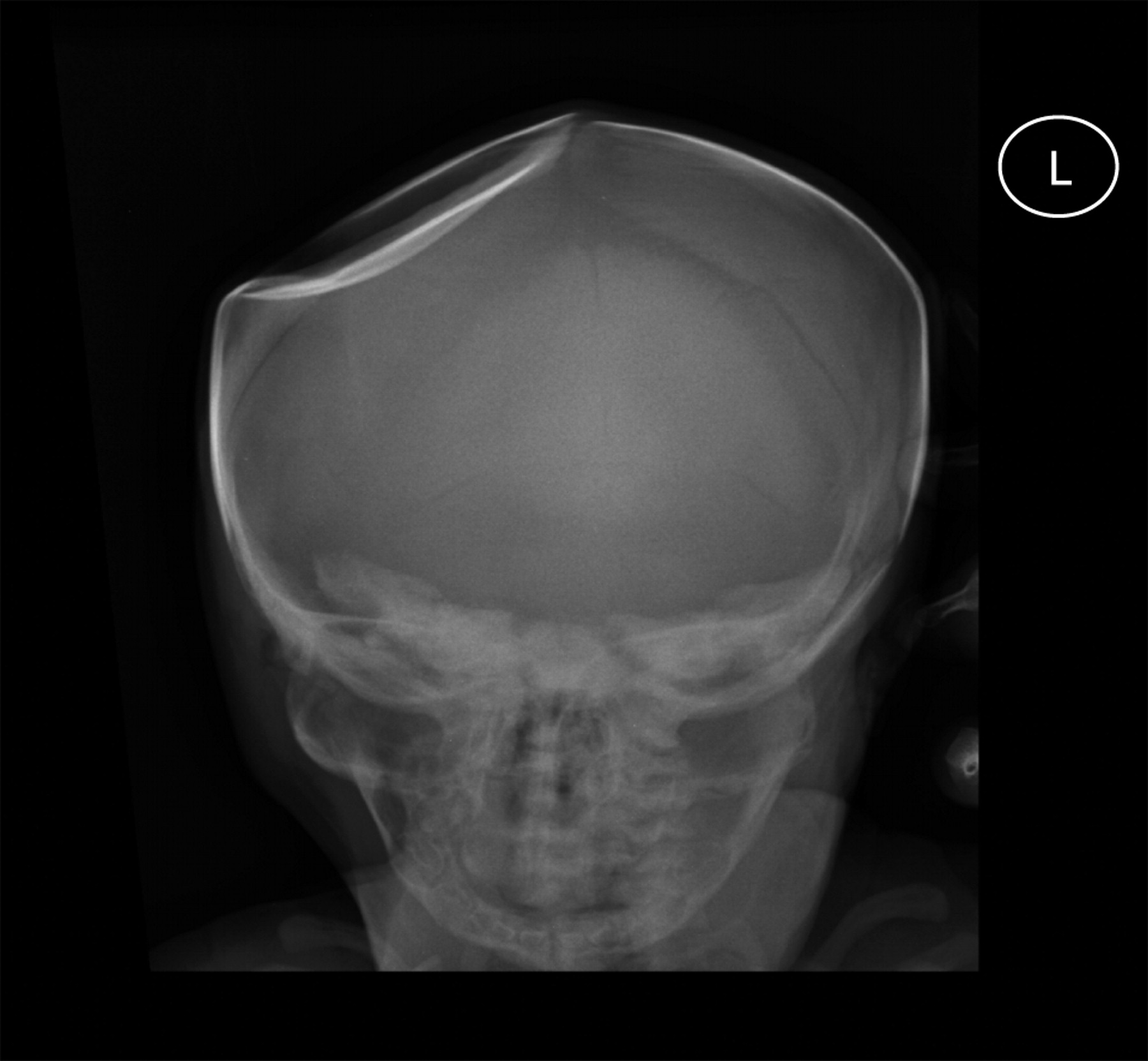
Question
| A. |
Depressed fracture
|
| B. |
Linear fracture
|
| C. |
Hinge fracture
|
| D. |
Gutter fracture
|
Show Answer
|
Correct Answer � A
Explanation
|
|
Depressed Fracture
– Bone fragments driven inward, possibly compressing brain.
– Seen on X-ray as localized skull concavity.
– Can be compound (scalp breach) or simple (no laceration).
– Surgical elevation needed if:
– Depression ≥5 mm
– Dural tear present
– Neurological deficits
– Open fracture
Why Other Options Are Incorrect:
B. Linear Fracture
– Thin radiolucent line, no bone displacement or indentation.
– Most common skull fracture in children.
– Not seen in this image.
C. Hinge Fracture
– Also called diastatic or basilar fracture.
– Fracture splits skull base into halves like a hinge.
– Usually diagnosed on CT, not evident on this X-ray.
D. Gutter Fracture
– Partial-thickness injury from grazing gunshot or glancing blows.
– Produces a groove or channel on skull surface.