
Question
| A. |
Hemolysin |
| B. |
Coagulase |
| C. |
Enterotoxin |
| D. |
Epidermolytic toxin |

|
Correct Answer » D Explanation |
 |
Detailed Explanation:
Anatomical Role
– The epidermis is the outermost skin layer, composed mainly of keratinocytes connected by desmosomes.
– Disruption of desmosomal adhesion causes skin blistering and desquamation.
Clinical Reasoning for the Correct Answer
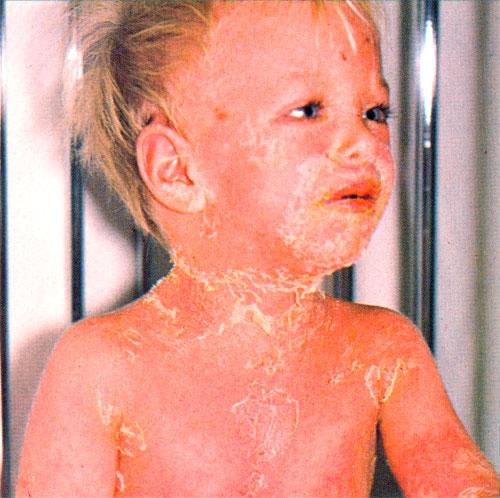
– The image shows large, flaccid blisters with superficial epidermal peeling, typical of Staphylococcal Scalded Skin Syndrome (SSSS).
– SSSS is caused by exfoliative or epidermolytic toxins (exfoliatins) produced by certain strains of Staphylococcus aureus.
– These toxins cleave desmoglein-1, a desmosomal cadherin that anchors superficial keratinocytes, causing epidermal splitting just below the stratum corneum.
– The clinical picture includes widespread erythema, superficial blisters, and positive Nikolsky sign (skin shears off easily).
Why Option A (Hemolysin) is Incorrect
– Hemolysins are bacterial toxins that lyse red blood cells, causing hemolysis; they do not cause skin blistering.
– Associated with bacterial virulence but not characteristic for exfoliative skin disease.
– Typical diseases include hemolytic infections and sepsis, not scalded skin.
Why Option B (Coagulase) is Incorrect
– Coagulase, produced by Staphylococcus aureus, promotes fibrin clot formation to protect bacteria but is not directly responsible for skin exfoliation.
– Important for pathogenesis but does not cause toxin-mediated skin desquamation.
Why Option C (Enterotoxin) is Incorrect
– Enterotoxins cause gastrointestinal symptoms like vomiting and diarrhea, characteristic of staphylococcal food poisoning.
– They are superantigens causing systemic symptoms, not localized skin blistering.
Differential Diagnoses
– Toxic epidermal necrolysis (has deeper epidermal necrosis).
– Bullous impetigo (localized form of SSSS, also caused by exfoliative toxin).
– Stevens-Johnson syndrome (usually drug-induced, mucosal involvement).
