Question
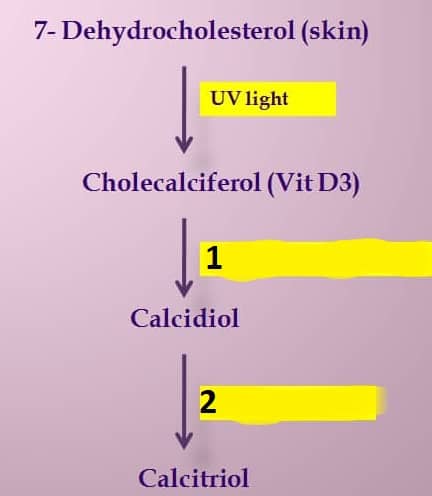
Identify the Enzymes:1 and 2 as shown in the image.
| A. |
Enzyme 1: 1 alpha-hydroxylase
Enzyme 2: 25 hydroxylase
|
| B. |
Enzyme 1: 1 alpha dehydroxylase
Enzyme 2: 25 dehydroxylase
|
| C. |
Enzyme 1: 25 hydroxylase
Enzyme 2: 1 alpha-hydroxylase
|
| D. |
Enzyme 1: 1 beta-hydroxylase
Enzyme 2: 25 hydroxylase
|
Show Answer
|
Correct Answer � C
Explanation
|
|
Ans:C.
Enzyme 1: 25 hydroxylase
Enzyme 2: 1 alpha-hydroxylase.
The synthesis of Vitamin D is shown in the image.
Vitamin D
- Vitamin D is the major vitamin involved in the absorption of calcium.
- Besides dietary intake, cutaneous synthesis is the other and more important source of vitamin D (cholecalciferol) in the body. The keratinocytes of stratum corneum of the epidermis of skin contain 7-dehydrocholesterol which is converted to Vitamin D3(cholecalciferol) by the action of sunlight (UV light).
- This vitamin D3 (Cholecalciferol) is converted to calcidiol (calcifediol or 25 hydroxy cholecalciferol or 25-hydroxy vitamin D3) by 25 hydroxylase in the liver.
- Calcidiol is the major circulating form of vitamin D3.
- Calcidiol is then converted to Calcitriol (1-25 dihydroxy-cholecalciferol or 1-25 dihydroxy vitamin D3) by 1-a hydroxylation in the kidney.
- The final hydroxylation in the kidney is the rate-limiting step.
- Calcitriol is the active form of vitamin D.
- Dietary vitamin D is absorbed in ileum and requires bile salts.
- When Ca2 level is high, little calcitriol is produced, and the kidney produces the relatively inactive metabolite 24, 25 dihydroxycholecalciferol instead.