Question
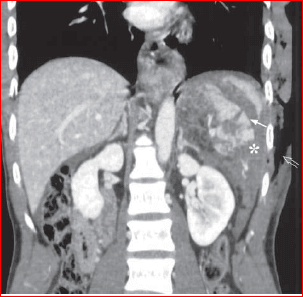
A 30-year-old woman accidentally fell from a height of 10 meters and landed on her left side. She subsequently complained of severe left upper abdominal pain. On general examination, she was pale and tachycardic but normotensive. Examination of the abdomen revealed marked tenderness over the left lower chest wall and left upper abdomen. A plain chest radiograph showed fractures of left lower ribs with evidence of a pneumothorax. Hemoglobin level remained low after transfusion of 2 units of blood. A CECT abdomen was performed for further evaluation. What is the possible diagnosis?
| A. |
Splenic Rupture
|
| B. |
Kidney Rupture
|
| C. |
Trauma to the Adrenal Gland
|
| D. |
Trauma to the renal artery
|
Show Answer
|
Correct Answer � A
Explanation
|
|
Ans: A.) Splenic Rupture.
Image shows: Contrast-enhanced computed tomography with coronal reformation showing the ruptured spleen (arrow). Note the presence of perisplenic hematoma (asterisk) and surgical emphysema (open arrow) in the left chest wall.
- Splenic rupture should be considered in any case of blunt abdominal trauma, particularly when the injury occurs to the left upper quadrant of the abdomen.
- Features of shock (pallor, tachycardia, restlessness, hypotension), pain, tenderness and abdominal rigidity in the left upper quadrant is seen.
- Dullness in the left flank which does not shift, as the collected blood gets clotted. Dullness without shifting— Ballance’s sign.
- Plain X-ray abdomen-
- Obliteration of splenic outline
Obliteration of psoas shadow (most important feature)
Indentation of fundic gas shadow
Fracture of lower ribs
Elevation of the left side of the diaphragm
Free fluid in the abdomen between coils of intestine
- CT scan will show the type of splenic injury and its class.CT is advantageous in showing damage to the other major organs, seen within continuous cuts through the abdomen, including liver, left kidney and aorta.