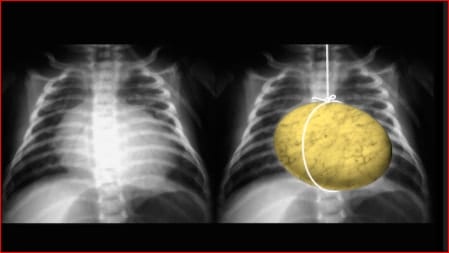
Question
In which congenital heart disease, the following type of X-ray is seen?
| A. |
Transposition of Great Arteries
|
| B. |
Ebstein’s Anomaly
|
| C. |
Tetralogy of Fallot
|
| D. |
Aortic Stenosis
|
Show Answer
|
Correct Answer � A
Explanation
|
|
Ans: A.Transposition of Great Arteries.
Image shows:
Transposition of Great Arteries:
- Transposition of the great arteries (TGA) (also known as transposition of the great vessels (TGV) is the most common cyanotic congenital cardiac anomaly presenting during the newborn period, with cyanosis in the first 24 hours of life. It accounts for up to 7% of all congenital cardiac anomalies and can be assessed with echocardiography, gated cardiac CT, or cardiac MRI.
Plain radiograph
- A frontal chest radiograph classically shows cardiomegaly with cardiac contours classically described as appearing like an egg on a string. There is often an apparent narrowing of the superior mediastinum as the result of the aortic and pulmonary arterial configuration, i.e. parallel in D-loop transposition, with the main pulmonary artery posterior to the aorta.