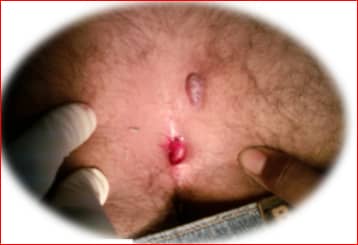
Question
A patient presented with an opening at the lowermost part of the back. It discharges pus. On examination, it looks like the image given. What can be the most possible diagnosis?
| A. |
Anal Fissure
|
| B. |
Anal Fisula
|
| C. |
Pilonidal Sinus
|
| D. |
Dermoid Cyst Fistula
|
Show Answer
|
Correct Answer � C
Explanation
|
|
Ans:C-Pilonidal Sinus.
Pilonidal disease
- It is an acquired disease.
- Although earlier it was thought to be a congenital disease, it is now considered to be an acquired infection of natal cleft hair follicles. The hair follicles become infected and rupture into the subcutaneous tissues to form a pilonidal abscess. Hair from surrounding skin is pulled into the abscess cavity by the friction generated by the gluteal muscles during walking.
- Branching tracts are common.
- Risk factors for the pilonidal disease include male gender, hirsute individuals, Caucasians, sitting occupations, the existence of a deep natal cleft, and the presence of hair within the natal cleft.
- A common affliction amongst the military, it has been referred to as ‘jeep disease’.
- Family history is seen in 38% of patients with pilonidal disease.
- Obesity is a risk factor for recurrent disease.
- More common in males.
- Treatment of choice is surgery.
- Pilonidal sinus should be excised along with the secondary openings. (But only after controlling acute infection). Acute pilonidal abscesses and sinus ds can be managed by simple incision and drainage (under local anesthesia).
- Prognosis after surgery is excellent.
- The recurrent or persistent disease has been reported to be 0-15% and is likely due to inadequate excision. Inadequate postoperative hygiene with ingrowth of hair into the wound also leads to recurrence.