
Question
| A. | A |
| B. |
B |
| C. |
C |
| D. |
D |

|
Correct Answer � C Explanation |
 |
Ans. C. C
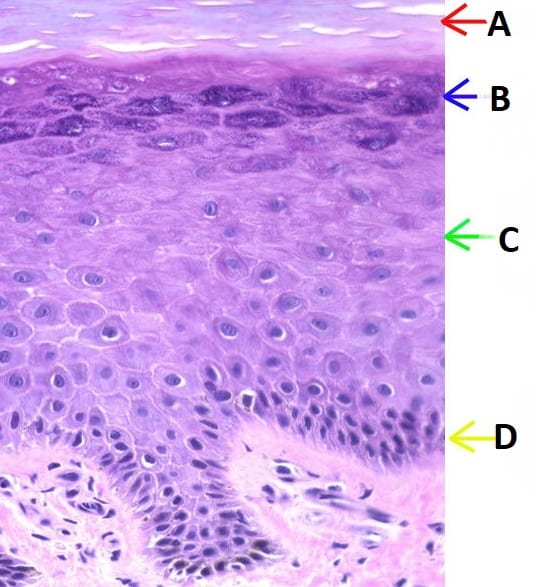
Stratum spinosum or prickle cell layer contains abundant desmosomes marked with the letter ‘C’ in the image.
| Picture shows layers of epidermis | |
| A | Stratum corneum |
| B | Stratum granulosum |
| C | Stratum spinosum |
| D | Stratum basale |
“The epidermis can be divided into a number of layers from deep to superficial as follows: basal layer (stratum basale), spinous or prickle cell layer (stratum spinosum), granular layer (stratum granulosum), clear layer (stratum lucidum) and cornified layer (stratum corneum)
“The prickle cell layer (stratum spinosum) consists of several layers of closely packed keratinocytes that interdigitate with each other by means of numerous cell surface projections. The cells are anchored to each other by desmosomes that provide tensile strength and cohesion to the layer. These suprabasal cells are committed to terminal differentiation and gradually move upwards towards the cornified layer as more cells are produced in the basal layer. When skin is processed for routine light microscopy, the cells tend to shrink away from each other except where they are joined by desmosomes, which gives them their characteristic spiny appearance. Prickle cell cytoplasm contains prominent bundles of keratin filaments, (mostly K1 and K10 keratin proteins) arranged concentrically around a euchromatic nucleus, and attached to the dense plaques by desmosomes. The cytoplasm also contains melanosomes, either singly or aggregated within membrane-bound organelles (compound melanosomes). Langerhans cells and the occasional associated lymphocyte are the only non-keratinocytes present in the prickle cell layer. “
| Layers of Epidermis | |
| Stratum basale |
Also known as stratum germinativum It contains mitotically active keratinocytes containing house keeping organelles (RER, golgi complex, mitochondria, lysosomes, ribosomes) Give rise to superficial layer |
| Stratum spinosum |
Spine like appearance of cell margins in histological sections
These spines are abundant desmosomes, calcium dependent cell surface modifications that promote adhesion of epidermal cells & resistance to mechanical stresses. |
| Stratum granulosum |
Characterized by buildup of components necessary for the process of programmed cell death & formation of superficial water impermeable barrier. Mostapparent structure within these cells is basophilic contain keratohyaline granules |
| Stratum lucidum | Clear layer, seen only in thick skin |
| Stratum corneum | Formed of cornified or horny cells (largest cell of epidermis) and have highest concentration |
