Question
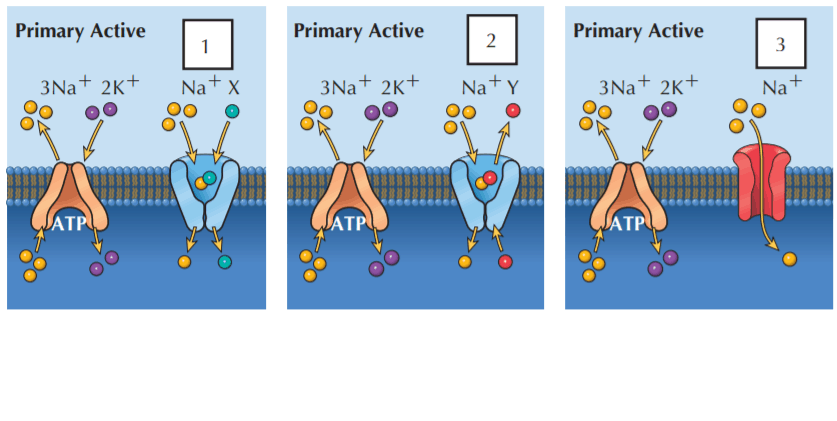
Which of the following order is correct for the mechanisms depicted in the image?
| A. |
1- Secondary active symporter, 2- Secondary Active Antiporter, 3- Passive channel
|
| B. |
1- Secondary active Antiporter, 2- Secondary Active symporter, 3- Passive channel
|
| C. |
1- Secondary active Antiporter, 2- Passive channel, 3- Secondary active Symporter
|
| D. |
1- Secondary active Symporter, 2- Passive channel, 3- Secondary active Antiporter
|
Show Answer
|
Correct Answer � A
Explanation
|
|
Ans. A. 1- Secondary active symporter, 2- Secondary Active Antiporter, 3- Passive channel.
- In the cells depicted, the primary active Na+ /K+ ATPase (also called the sodium pump) maintains low intracellular sodium concentrations, creating an out-to-in gradient for sodium.
- This allows the secondary active transport of other molecules (X and Y in the figure) through many different transporters.
- It also results in the passive movement of sodium or potassium (leak) through channels back into cells (sodium) or out of cells (potassium).



