Question
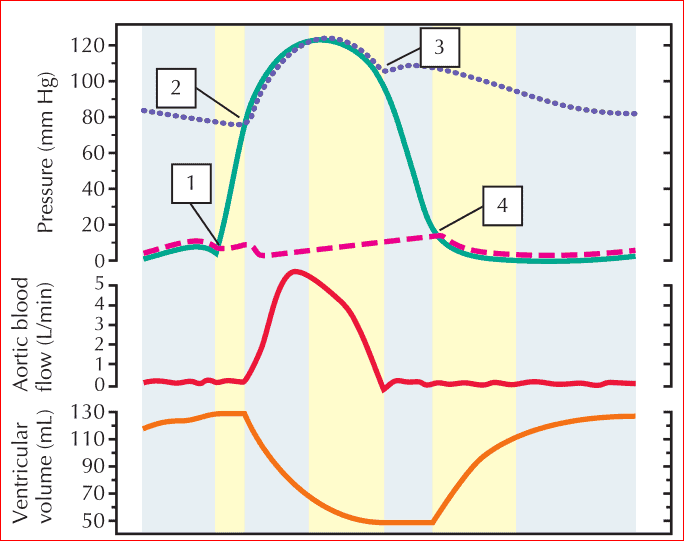
Identify the valve involved during the stages marked at labelled points, in order?
| A. |
Mitral valve closure, Aortic valve opening, Aortic valve closure & Mitral valve opening
|
| B. |
Mitral valve opening, Aortic valve closure, Aortic valve opening & Mitral valve closure.
|
| C. |
Pulmonary valve opening, Aortic valve closure, Aortic valve opening & Pulmonary valve closure.
|
| D. |
Aortic valve closure, Pulmonary valve opening, Pulmonary valve closure & Aortic valve opening.
|
Show Answer
|
Correct Answer � A
Explanation
|
|
Ans. A. Mitral valve closure, Aortic valve opening, Aortic valve closure & Mitral valve opening.
- The mitral and tricuspid valves, also known as the atrioventricular, or AV valves, open during ventricular diastole to permit filling.
- Due to the contractions of the systole, pressures in the ventricles rise quickly, exceeding the pressures in the trunks of the aorta and the pulmonary arteries and causing the requisite valves (the aortic and pulmonary valves) to open-which results in separated blood volumes being ejected from the two ventricles.
- This is the ejection stage of the cardiac cycle.
Detailed description:
Atrial Contraction –
- As the atria contract, the pressure within the atrial chambers increases, which forces more blood flow across the open atrioventricular (AV) valves, leading to a rapid flow of blood into the ventricles.
Isovolumetric Contraction –
- During the period between the closure of the AV valves and the opening of the aortic and pulmonic valves, ventricular pressure rises rapidly without a change in ventricular volume (i.e., no ejection occurs).
- Ventricular volume does not change because all valves are closed during this phase.
- Contraction, therefore, is said to be “isovolumic” or “isovolumetric.”
Rapid Ejection –
- This phase represents initial, rapid ejection of blood into the aorta and pulmonary arteries from the left and right ventricles, respectively.
- Ejection begins when the intraventricular pressures exceed the pressures within the aorta and pulmonary artery, which causes the aortic and pulmonic valves to open.
Rapid Filling –
- As the ventricles continue to relax at the end of phase 5, the intraventricular pressures will at some point fall below their respective atrial pressures.
- When this occurs, the AV valves rapidly open and passive ventricular filling begins.