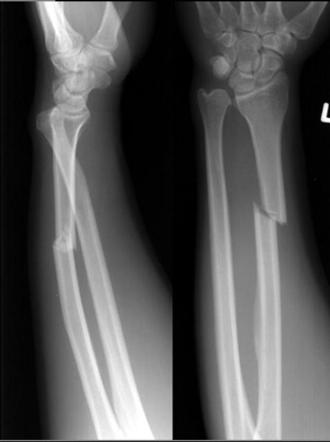
Question
| A. |
Barton’s Fracture
|
| B. |
Monteggia’s Fracture-Dislocation
|
| C. |
Piedmont’s Fracture
|
| D. |
Colles’ Fracture
|
Show Answer
|
Correct Answer � C
Explanation
|
|
Ans.C. Galeazzi Fracture (Piedmont Fracture)
- Galeazzi fracture-dislocations consist of fractures of the distal part of the radius with dislocation of the distal radioulnar joint and an intact ulna.
Epidemiology
- Galeazzi fractures are primarily encountered in children, with a peak incidence at age 9-12 years. In adults, it is estimated to account for ~7% of forearm fractures.
Mechanism
- Typically, Galeazzi fracture-dislocations occur due to a fall on an outstretched hand (FOOSH) with the elbow in flexion.
Radiographic features
Galeazzi fractures are classified according to the position of the distal radius:
- type I: dorsal displacement.
- type II: volar displacement.