
Question
| A. | Left |
| B. |
Right |
| C. |
Both |
| D. |
Either of these |

|
Correct Answer � A Explanation |
 |
Ans. A, Left
-
“Laryngoscope is held by the handle in the left hand.
-
Right hand is used to retract the lips and guide the laryngoscope and to handle suction and instruments.
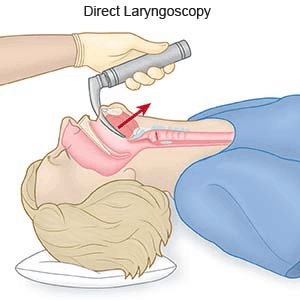
Direct laryngoscopy.
-
In this procedure, the larynx is directly examined with a rigid laryngoscope or fiberoptic laryngoscope.
-
Position of patient – Boyce position/Barking-dog position.
Indications
1. Diagnostic purposes:
-
When a lesion in the larynx, as seen in indirect laryngoscopy, needs further evaluation to know its nature or extent, a direct view of the larynx is necessary.
-
When indirect laryngoscopy is not possible as in children.
-
If an elongated in-curled epiglottis obscures the view of the endolarynx.
-
To know about the pathological lesions in blind areas of the larynx.
2. Therapeutic purposes :
a. Direct laryngoscopy is done for intubation, for administering general anaesthesia and to have a control on the airway.
b. For removal of foreign bodies in the larynx, thickened secretions and crusts.
c. For performing various operations like removal of cordal nodules, vocal polyps, cysts, taking a biopsy, etc.
Contraindications for Direct Laryngoscopy
1. In injuries and disease of the cervical spine, direct laryngoscopy is hazardous as the endoscopic procedure and the patient’s movements might lead to spinal cord damage.
2. Trismus, long incisor teeth, and a short and thick neck make the procedure difficult.
