Question
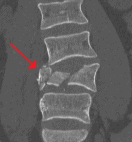
What is the fracture shown in the given image:
| A. |
Unstable burst fracture
|
| B. |
Flexion distraction injury
|
| C. |
Translational injury
|
| D. |
Chance fracture
|
Show Answer
|
Correct Answer � A
Explanation
|
|
Answer A) Unstable burst fracture
Burst fracture of L4 on CT scan is shown in the image
Burst Fracture
Burst fractures are a type of compression fracture related to high-energy axial loading spinal trauma that results in disruption of the posterior vertebral body cortex with retropulsion into the spinal canal.
Pathology
Burst fractures most commonly occur at L1 with the majority (~90%) occurring from T9-L5. Two-level burst fractures are much less common than single-level burst fractures
Classification: (stable or unstable)
– Stable Burst Fracture:
neurologically intact;
posterior arch remains intact: pedicle widening implies post arch disruption with instability;
less than 50% anterior body height collapse
compression fractures:
– Unstable Burst Fracture:
neurologic deficit;
loss of 50% of vertebral body height;
fracture dislocation:
thoracolumbar burst fracture:
angulation of the thoracolumbar junction > 20 degree
canal compromise > 30 percent