Question
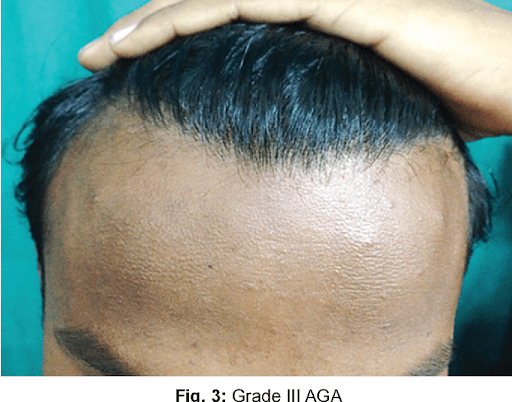
A 35-year-old man comes to the physician for evaluation of progressive hair loss from his scalp. He first noticed receding of the hairline over the bitemporal regions of his scalp 5 years ago. Since then, his hair has gradually become thinner over the crown of his head. He is otherwise healthy and takes no medications. Examination shows diffuse, nonscarring hair loss over the scalp with a bitemporal pattern of recession. Administration of which of the following drugs is most appropriate to treat this patient’s hair loss?
| A. |
Griseofulvin
|
| B. |
Triamcinolone
|
| C. |
Levothyroxine
|
| D. |
Finasteride
|
Show Answer
|
Correct Answer � D
Explanation
|
|
Ans-D-Finasteride
Griseofulvin
Griseofulvin is used to treat tinea infections such as tinea capitis, which typically causes round, pruritic, scaly plaques with broken hair shafts and irregular patches of hair loss, unlike this patient’s manifestations. This condition is more common among young children but can develop in adults. Griseofulvin is not used to treat androgenetic alopecia.
Triamcinolone
Intralesional triamcinolone is the first-line therapy for alopecia areata, which causes nonscarring hair loss similar to this patient’s manifestations. However, alopecia areata typically causes acute-onset, well-demarcated patches of hair loss in contrast to this patient’s chronic history of progress and diffuse hair loss. Intralesional triamcinolone is not used to treat androgenetic alopecia.
Levothyroxine
Levothyroxine is used to treat hypothyroidism, a trigger of telogen effluvium. Patients with telogen effluvium experience increased shedding of telogen hair; usually > 10% of hair can be removed if ~ 50 hairs are grasped and gently tugged away from the scalp (positive hair pull test). Although the hair loss of telogen effluvium is diffuse and nonscarring, it is typically acute in onset. Additionally, this patient does not have signs and symptoms of hypothyroidism (e.g., fatigue, bradycardia, cold intolerance, constipation, weight gain). Levothyroxine is not used to treat androgenetic alopecia.
Finasteride
Finasteride, a 5-alpha reductase inhibitor, is a first-line therapy for men with androgenetic alopecia that decreases the conversion of testosterone to dihydrotestosterone, a circulating androgen responsible for the manifestations of this condition. Adverse effects include gynecomastia and sexual dysfunction (e.g., decreased libido, erectile dysfunction).