Question
A patient presented with lower limb weakness. The examiner places one hand under the patient’s heel and the patient is then asked to raise his other leg against downward resistance. What is the test being performed?
| A. |
Hoover’s Test
|
| B. |
O’Donoghue Test
|
| C. |
Waddell’s Test
|
| D. |
Mc Bride Test
|
Show Answer
|
Correct Answer � A
Explanation
|
|
Answer A) Hoover’s Test
Hoover Test
The purpose of the test is to distinguish between leg paresis that is psychogenic from that which is genuine.
Genuine leg weakness seen in paresis is considered to be “organic,” and other causes of leg paresis that is not related to a neuropathological process is considered to be “nonorganic.”
Technique
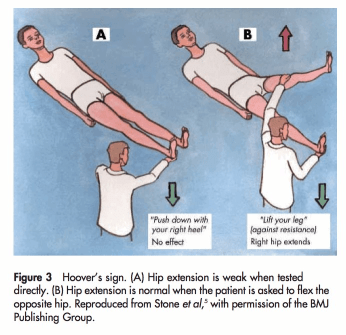
Hoover’s sign is a motor sign. It is based on the principle of crossed extensor reflex. The patient is placed in a supine/recumbent position.
The examiner places his/her hand under the patient’s heel. The patient is then instructed to press the heels down onto the table.
The examiner is expected to feel pressure on the non-paretic limb. The patient is then asked to raise his/her non-paretic limb against downward resistance applied by the therapist.
No pressure is expected to be felt under the paretic leg that is on the table.The Hoover’s sign is when pressure is felt in the paretic leg when the non-paretic leg is raised and no pressure is felt in the non-paretic leg when the paretic leg is being raised.
Evidence
Sensitivity 63%
Specificity 100%
Hoover’s sign was moderately sensitive and very specific for a diagnosis of functional weakness.