Question
A 54-year-old woman comes to the physician because of a 1-day history of fever, chills, and double vision. She also has a 2-week history of headache and foul-smelling nasal discharge. Her temperature is 39.4°C (103°F). Examination shows mild swelling around the left eye. Her left eye does not move past midline on far left gaze but moves normally when looking to the right. Without treatment, which of the following findings is most likely to occur in this patient?
| A. |
Relative afferent pupillary defect
|
| B. |
Jaw deviation
|
| C. |
Absent corneal reflex
|
| D. |
Hypoesthesia of the earlobe
|
Show Answer
|
Correct Answer � C
Explanation
|
|
Answer C) Absent corneal reflex
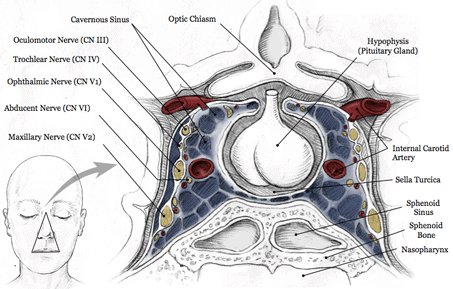
This patient has manifestations of acute bacterial sinusitis (e.g., fever, headache, foul-smelling nasal discharge). She also has periorbital edema and abducens nerve palsy, which is often the earliest cranial nerve palsy that develops as a result of cavernous sinus thrombosis, which is a rare but dangerous complication of acute bacterial sinusitis.
Cavernous sinus thrombosis
-
Cavernous sinus thrombosis with impaired venous drainage can result in compression of the ophthalmic branch of the trigeminal nerve (CN V1), which passes through the cavernous sinus.
-
As a result, patients present with absent corneal reflex, as well as impaired sensation in the upper face.
-
Progression of the thrombus can cause compression of the oculomotor nerve (CN III), trochlear nerve (CN IV), and abducens nerve (CN VI), resulting in ophthalmoplegia.
-
Other causes of cavernous sinus thrombosis include otitis media, infections of the maxillary teeth, bacteremia, and trauma.
Jaw deviation
-
Jaw deviation can occur if the mandibular branch of the trigeminal nerve (CN V3), which innervates the muscles of mastication, is damaged.
-
The nerve reaches the skull base through the foramen ovale; it does not pass through the cavernous sinus and is therefore not affected by cavernous sinus thrombosis.
Relative afferent pupillary defect
-
A relative afferent pupillary defect (Marcus Gunn pupil) occurs if the optic nerve (CN II) is damaged. The optic nerve arises from the optic chiasm, which lies above the cavernous sinus.
-
It then passes through the optic canal to enter the orbital cavity.
-
Since the optic nerve does not lie in the cavernous sinus, a relative afferent pupillary defect would not be expected.
Hypoesthesia of the earlobe
The nerve reaches the skull base through the foramen ovale; it does not pass through the cavernous sinus and is therefore not affected by cavernous sinus thrombosis.