
Question

| A. | Chronic Respiratory Acidosis & Metabolic Acidosis Metabolic |
| B. |
Metabolic Alkalosis & Metabolic Acidosis |
| C. |
Acute Respiratory Acidosis & Chronic Respiratory acidosis |
| D. |
Acute Respiratory Acidosis & Metabolic Acidosis |

|
Correct Answer � A Explanation |
 |
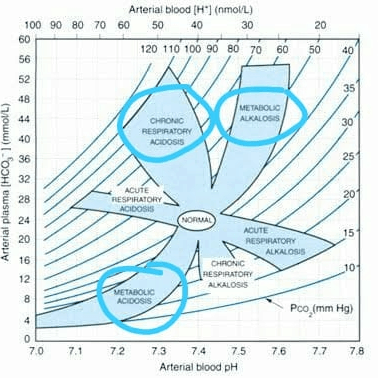
Ans. A. Chronic Respiratory acidosis & metabolic acidosis
-
The graph represents “Acid–base nomogram”.
-
Changes in the PCO2 (curved lines), plasma HCO3– , and pH (or H + ) of arterial blood in respiratory and metabolic acidosis are shown.
-
Note the shifts in HCO3– and pH as acute respiratory acidosis and alkalosis are compensated, producing their chronic counterparts.
Respiratory acidosis – Mechanism:
-
Any short-term rise in arterial PCO2 (ie, above 40 mm Hg) due to decreased ventilation results in respiratory acidosis.
-
The CO2 that is retained is in equilibrium with H2CO3 , which in turn is in equilibrium with HCO3– , so that the plasma HCO3 – rises and a new equilibrium is reached at a lower pH.
-
This can be indicated graphically on a plot of plasma HCO 3 – concentration versus pH.
-
The pH change observed at any increase in P CO 2 during respiratory acidosis is dependent on the buffering capacity of the blood
Metabolic Acidosis & Alkalosis – Mechanism:
-
Blood pH changes can also arise by nonrespiratory mechanism.
-
Metabolic acidosis (or non respiratory acidosis) occurs when strong acids are added to blood. If, for example, a large amount of acid is ingested (eg, aspirin overdose), acids in the blood are quickly increased, lowering the available Hb – , Prot – , and HCO 3 – buffers.
-
The H2CO3 that is formed is converted to H2O and CO2 , and the CO2 is rapidly excreted via the lungs.
-
This is the situation in uncompensated metabolic acidosis.
-
When the free H + level falls as a result of addition of alkali, or more commonly, the removal of large amounts of acid (eg, following vomiting), metabolic alkalosis results.
-
In uncompensated metabolic alkalosis the pH rises along the isobar line
Respiratory Alkalosis – Mechanism:
-
Any short-term decrease in ventilation that lowers PCO2 below what is needed for proper CO2 exchange (ie, below 35 mm Hg) results in respiratory alkalosis.
-
The decreased CO2 shifts the equilibrium of the carbonic acid–bicarbonate system to effectively lower the H + and increase the pH.
-
As in respiratory acidosis, initial pH changes corresponding to respiratory alkalosis are those that occur independently of any compensatory mechanism and are thus uncompensated respiratory alkalosis.
