Question
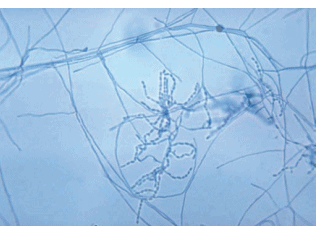
A chest radiograph reveals cavitary lesions. Growth of the organism on buffered charcoal yeast extract (BCYE) agar is slow and characterized by the formation of aerial hyphae. Gram stain of the cultured organism is shown in the photograph. What is the etiology of this disease?
| A. |
Nocardia asteroides
|
| B. |
Histoplasma capsulatum
|
| C. |
Legionella pneumophila
|
| D. |
Mycobacterium tuberculosis
|
Show Answer
|
Correct Answer � A
Explanation
|
|
Answer-A
Nocardia stains weakly Gram-positive and is partially acid fast (does not uniformly pick up the acid-fast stain). It has a beaded appearance in stained specimens as shown
in the picture. Growth of the organism is slow, and rapidly growing commensal organisms in sputum can prevent detectable growth of Nocardia. Thus, if this organism is suspected, the laboratory should be advised to culture on a selective media such as BCYE, a medium used for the isolation of Legionella. The filamentous appearance of Nocardia in stained specimens and the formation of aerial hyphae in culture resembles fungi. Histoplasma, however, does not appear as filaments in sputum. Rather, yeast forms can be seen in sputum stained with giemsa or periodic acid-Schiff. Although pulmonary disease can result from infection with Coccidioides immitis, it appears in sputum as endosporulation spherules.