
Question
| A. |
Malignant melanoma |
| B. |
Cataract |
| C. |
Loss of vision |
| D. |
Glaucoma |

|
Correct Answer » A Explanation |
 |
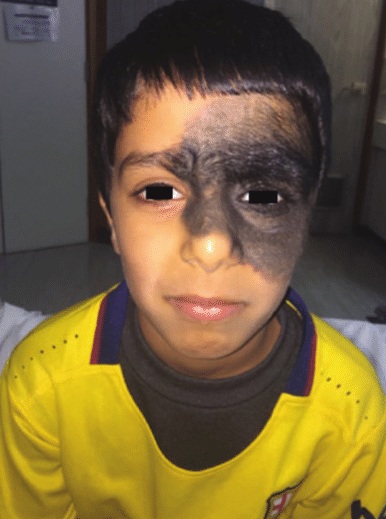
The congenital melanocytic nevus appears as a circumscribed, light brown to black patch or plaque, potentially very heterogeneous in consistency, covering any size surface area and any part of the body.
As compared with a melanocytic nevus, congenital melanocytic nevi are usually larger in diameter and may have excess terminal hair, a condition called hypertrichosis. If over 40 cm (16 in) projected adult diameter with hypertrichosis, it is sometimes called giant hairy nevus; more usually these largest forms are known as large or giant congenital melanocytic nevus.
A giant congenital melanocytic nevus (GCMN) is found in 0.1% of live-born infants.
If present, the lesion has a chance of about 6% to develop into malignant melanoma.
Both children and adults can be affected by malignant melanoma arising in a giant congenital nevus.
Up to 95% of GCMNs harbor NRAS mutations, and mutations in the BRAF, MC1R, TP53, and GNAQ genes have also been described.
