Question
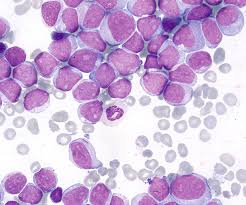
A 36-year-old woman presents with progressive fatigue, pallor, and bleeding gums over the past few weeks. On examination, she is markedly pale with gingival hypertrophy. Peripheral smear is shown below. Which of the following chromosomal translocation would be responsible
| A. |
AML with t(15:17)
|
| B. |
AML with inv 16
|
| C. |
AML with t(8:21)
|
| D. |
AML with mutated NPM1
|
Show Answer
|
Correct Answer » A
Explanation
|
|
The scenario suggests Acute Myeloid Leukemia (AML), specifically Acute Promyelocytic Leukemia (APML), a subtype of AML.
– Gum hyperplasia is indicative of APML.
– In the smear:
– Promyelocytes accumulate in APML.
– Faggot cells have multiple Auer rods, pathognomonic for AML.
– Bilobed or folded nuclei are characteristic of promyelocytes.
The hallmark of APML is the translocation t(15:17), forming the PML-RARA fusion gene.
Incorrect Options:
– B. AML with inv(16): Linked with M4Eo AML; lacks gum hyperplasia.
– C. AML with t(8:21): Found in AML M2; lacks gum hyperplasia.
– D. AML with mutated NPM1: Not associated with gum hyperplasia.
The specific feature of gum hyperplasia points to the t(15:17) translocation.