Question
A 3-year-old child is presented with episodes of vomiting, lethargy, and poor feeding. The physician suspected a disorder of urea cycle based on clinical findings. Blood test results showed increased glutamine levels. Which enzyme deficiency is most likely responsible for these findings?
| A. |
Arginosuccinate lyase
|
| B. |
Alpha-galactosidase-A
|
| C. |
Ornithine transcarbamoylase
|
| D. |
Arginase
|
Show Answer
|
Correct Answer � C
Explanation
|
|
The correct answer is C. Ornithine transcarbamoylase.
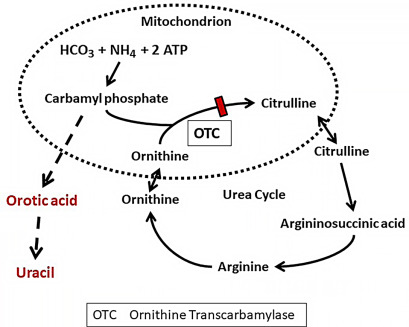
Deficiency of this enzyme is a common cause of urea cycle disorders, and it results in the accumulation of ammonia in the blood. The body tries to detoxify this ammonia by converting it to glutamine, which leads to
elevated glutamine levels in the blood.
Why the other options can be ruled out:
- A. Arginosuccinate lyase: Deficiency of arginosuccinate lyase leads to argininosuccinic aciduria, a condition characterized by elevated levels of argininosuccinate in the blood and urine. This does not primarily cause increased glutamine in blood.
- B. Alpha-galactosidase-A: Deficiency of this enzyme results in Fabry disease, a lysosomal storage disorder. The primary clinical manifestations include neuropathic pain, angiokeratomas, and renal dysfunction. Elevated glutamine is not a typical finding of Fabry disease.
- D. Arginase: Arginase deficiency leads to argininemia, which is associated with an accumulation of arginine in the blood. While hyperammonemia can occur, elevated glutamine is not the primary distinguishing feature of this disorder.