Question
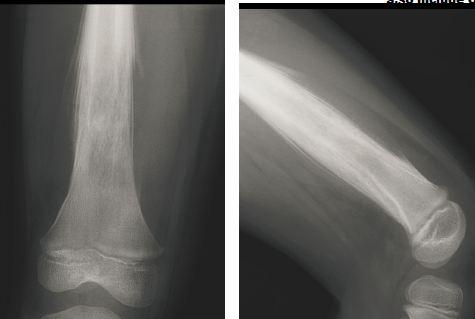
An 18-year-old boy presents with fever, localized bone pain, tenderness, and warmth over the affected area. Laboratory investigations reveal elevated ESR and CRP. A plain radiograph shows a lytic lesion with periosteal reaction described as an “onion-skin” appearance. What is the most likely diagnosis?
| A. |
Ewing’s sarcoma
|
| B. |
Osteosarcoma
|
| C. |
Osteomyelitis
|
| D. |
Giant cell tumor
|
Show Answer
|
Correct Answer » A
Explanation
|
|
– Ewing’s sarcoma typically affects children & adolescents (10–20 years).
– Symptoms include fever, localized bone pain, swelling, & systemic signs.
– Lab findings: ↑ ESR & CRP, and sometimes leukocytosis.
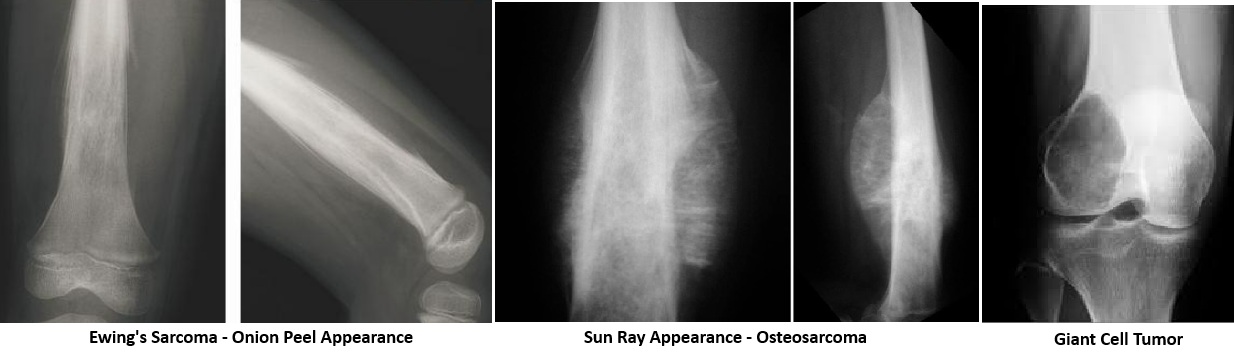
– X-ray: “Onion-skin” periosteal reaction & diaphyseal location in long bones (e.g., femur, tibia).
– Often shows an associated soft tissue mass.
Incorrect Options:
– Osteosarcoma: Bone pain & swelling, but fever rare. X-ray shows “sunburst” pattern or Codman’s triangle; occurs in metaphysis.
– Osteomyelitis: Fever, pain, ↑ ESR/CRP; X-ray: irregular lytic lesions & sequestrum, no “onion-skin.” Confirmed by positive cultures/biopsy.
– Giant Cell Tumor: Occurs in 20–40 years; lytic lesion in epiphysis, extending to articular surface; lacks fever/systemic signs.