
Question
| A. |
Pain |
| B. |
Temperature |
| C. |
Touch |
| D. |
Pressure |

|
Correct Answer � D Explanation |
 |
Pacinian corpuscles are specialized mechanoreceptors located deep in the skin, as well as in other areas like the joints, tendons, and abdominal mesentery. They are primarily sensitive to pressure and vibration.
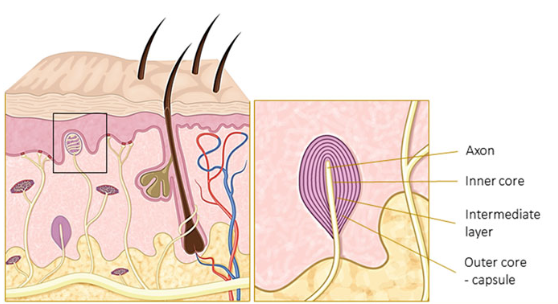
How Pacinian Corpuscles Work:
Structure: Pacinian corpuscles have a layered, onion-like structure that makes them particularly responsive to deep pressure and high-frequency vibration.
Function: When pressure or vibration is applied to the skin, it deforms the layers of the corpuscle, leading to a mechanical change that generates an electrical signal. This signal is then transmitted as a nerve impulse to the central nervous system.
Adaptation: Pacinian corpuscles are rapidly adapting receptors, meaning they respond quickly to the onset and removal of pressure but not to sustained pressure. This makes them particularly sensitive to dynamic changes in pressure, such as vibration.
Other Options
Pain: Pain is detected by nociceptors, which are specialized sensory receptors distinct from Pacinian corpuscles.
Temperature : Temperature is detected by thermoreceptors, which respond to changes in heat or cold, not pressure.
Touch: Light touch is primarily sensed by Meissner’s corpuscles and Merkel cells, which are located closer to the skin surface.
