Question
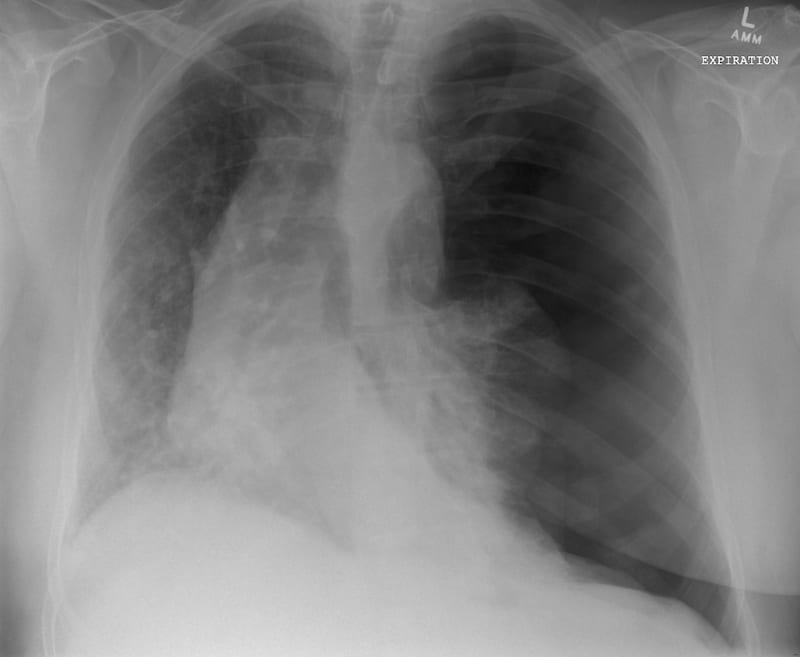
A 32-year-old male presents to the emergency department after sustaining a stab wound to the left side of his chest. He is in acute distress, with a heart rate of 120 beats per minute, blood pressure of 90/60 mm Hg, and respiratory rate of 28 breaths per minute. On physical examination, there are decreased breath sounds on the right side. A chest X-ray is shown. What is the diagnosis?
| A. |
Pneumothorax
|
| B. |
Hemothorax
|
| C. |
Tension Pneumothorax
|
| D. |
Hydrothorax
|
Show Answer
|
Correct Answer » C
Explanation
|
|
Based on the clinical findings and the chest X-ray, this patient likely has a tension pneumothorax. Let’s break down the features that support this diagnosis.
Key Clinical Findings Supporting Tension Pneumothorax
» Stab wound to the chest: This is a common cause of pneumothorax due to lung injury, and tension pneumothorax may develop if air is trapped and cannot escape.
» Vital signs: The patient is tachycardic (heart rate 120 bpm), hypotensive (BP 90/60 mm Hg), and tachypneic (RR 28 breaths per min), which are signs of shock and respiratory distress.
» Decreased breath sounds on the affected side: This is a common finding in tension pneumothorax as the lung collapses and cannot expand properly.
Chest X-Ray Findings (Supporting Tension Pneumothorax):
» Hyperlucency on the affected side: This suggests a large amount of air in the pleural space.
» Mediastinal shift to the opposite side: In tension pneumothorax, the increasing pressure from trapped air causes a shift of mediastinal structures toward the unaffected side. This shift is visible on the chest X-ray.
» Depressed diaphragm on the affected side: This can also occur in tension pneumothorax as the increased intrathoracic pressure pushes downward.
Other Options:
Pneumothorax: A simple pneumothorax would cause lung collapse and decreased breath sounds on the affected side, but it would not lead to mediastinal shift or severe hypotension.
Hemothorax: Hemothorax would present with dullness to percussion and may show a fluid level on the X-ray. Additionally, hemothorax does not cause a mediastinal shift, which is seen here.
Hydrothorax: Hydrothorax (fluid in the pleural space) is rare in trauma and would not cause a mediastinal shift or hyperlucency. It is typically associated with other conditions like heart failure.