Question
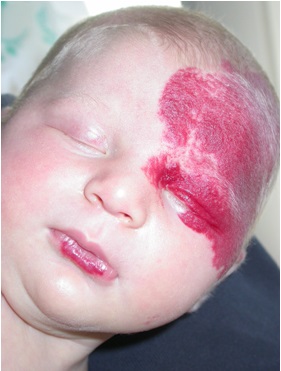
A baby presents with a distinctive skin finding as shown in the image below, making an accurate diagnosis is crucial for determining the appropriate management and prognosis. What is the probable diagnosis?
| A. |
Port Wine stain
|
| B. |
Cavernous hemangioma
|
| C. |
Naevus simplex
|
| D. |
Infantile Capillary hemangioma
|
Show Answer
|
Correct Answer » D
Explanation
|
|
The image shows a:
- Bright red vascular plaque.
- Unilateral involvement of the forehead and upper eyelid.
- Well-demarcated lesion.
- Thickened, superficial appearance.
- Segmental distribution over the face.
These features are characteristic of a segmental infantile capillary hemangioma.
D. Infantile capillary hemangioma
- Most common benign vascular tumor of infancy.
- Usually appears during the first few weeks of life, although a faint precursor lesion may be present at birth.
- Undergoes:
- Rapid proliferative phase (first 6–12 months).
- Plateau phase.
- Gradual involution over several years.
- Segmental facial hemangiomas are associated with PHACE syndrome:
- Posterior fossa malformations.
- Hemangioma.
- Arterial anomalies.
- Cardiac defects/Coarctation of aorta.
- Eye abnormalities.
Treatment:
- Observation for small uncomplicated lesions.
- Oral propranolol is the treatment of choice for problematic hemangiomas.
- Topical timolol may be used for superficial lesions.
Why the Other Options are Incorrect
A. Port-wine stain (Nevus flammeus)
- Congenital capillary malformation.
- Flat pink to purple lesion.
- Does not proliferate.
- Persists throughout life.
- Associated with Sturge-Weber syndrome, especially in the V1 distribution.
- Unlike the image, it lacks the characteristic proliferative, thickened appearance of an infantile hemangioma.
B. Cavernous hemangioma
- Deep vascular lesion.
- Bluish, compressible swelling.
- Located within subcutaneous tissues.
- Not a superficial bright-red plaque.
C. Naevus simplex (Salmon patch)
- Pale pink vascular lesion.
- Commonly occurs over the glabella, eyelids, or nape of the neck.
- Usually bilateral.
- Spontaneously fades during infancy.