
Question
Which of the following assists in the movement of supination and pronation of the forearm?
| A. |
Pivot joint |
| B. |
Saddle joint |
| C. |
Ellipsoid joint |
| D. | Ball and socket joint |

|
Correct Answer � A Explanation |
 |
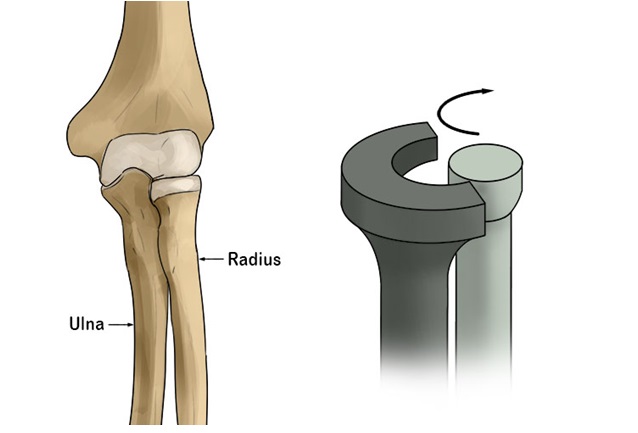
The pivot joint is the type of joint that facilitates the movements of supination and pronation of the forearm. In these movements, the radius and ulna rotate around each other. Specifically, in a pivot joint, a cylindrical bony process rotates within a ring composed partly of bone and partly of ligament.
An example of this is the proximal radioulnar joint, where the head of the radius rotates within the radial notch of the ulna, enabling the forearm to turn so that the palm faces up (supination) or down (pronation).
Reasons to rule out other options
B. Saddle joint: This joint allows movement along two axes, such as in the carpometacarpal joint of the thumb. It permits movements such as flexion, extension, abduction, and adduction, but it is not primarily involved in the supination or pronation of the forearm.
C. Ellipsoid joint: Also known as a condyloid joint, this type of joint allows angular motion in two planes, such as flexion-extension and abduction-adduction, like the wrist joint between the radius and the carpal bones. However, it does not directly facilitate the rotational movement of supination and pronation.
D. Ball and socket joint: This joint allows the most freedom of movement, including rotation, but in the context of the forearm, it does not directly contribute to the specific actions of supination and pronation. This joint type is exemplified by the shoulder and hip joints.
