
Question
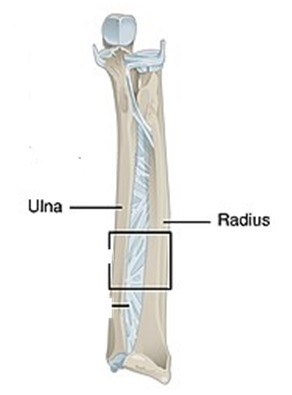
Identify the type of joint shown in the given image.
| A. |
Symphysis |
| B. |
Syndesmosis |
| C. | Synchondrosis |
| D. | Synostosis |

|
Correct Answer � B Explanation |
 |
The image is of the middle radio ulnar joint which is formed by the interosseous ligament. This is a type of fibrous joint which is syndesmosis.
A syndesmosis is a type of fibrous joint in which bones are joined together by a band of connective tissue, typically collagen fibers or ligaments. This joint allows for more movement than a suture (as found in the skull) but is still relatively immobile compared to other types of joints like synovial joints.
Examples of Syndesmoses
Distal Tibiofibular Joint: Perhaps the most well-known example, this syndesmosis connects the distal ends of the tibia and fibula. It is crucial for the stability of the ankle joint.
Interosseous Membrane of the Forearm: This membrane connects the radius and ulna, allowing for the transmission of forces across the forearm, as well as serving as an attachment site for muscles of the forearm.
Interosseous Membrane of the Leg: Similar to that of the forearm, this membrane connects the tibia and fibula, playing a key role in the stability of the leg and providing surface area for muscle attachment.
Reasons to rule out other options
Option A – Symphysis: Symphysis is a type of joint that is formed by the fusion of two bones by fibrocartilage. This type of joint allows for a limited amount of movement and is found in areas where shock absorption and flexibility are important, such as the pubic symphysis in the pelvis and the intervertebral discs in the spine.
Option C – Synchondrosis: Synchondrosis is a type of joint that is formed by the hyaline cartilage that connects two bones. This type of joint is found in areas where growth and development are occurring, such as the epiphyseal plates in children, and it gradually ossifies or becomes bone as the individual matures.
Option D – Synostosis: Synostosis is a type of joint that occurs when two bones fuse together to form a single bone. This fusion can occur due to a variety of reasons, such as trauma, surgery, or a congenital abnormality.
Examples of synostosis include the fusion of the cranial sutures in the skull and the fusion of the radius and ulna bones in the forearm. Unlike the other types of joints, synostosis does not allow for any movement.
