Question
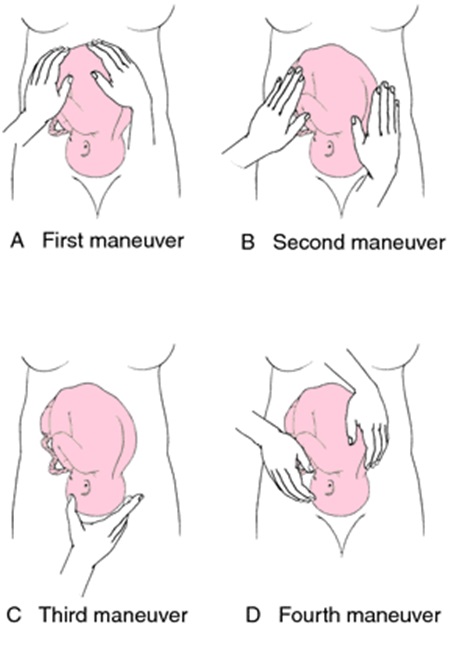
The image below depicts one of the Leopold manoeuvres performed during abdominal examination in pregnancy. Identify the obstetric grip shown.
| A. |
Fourth Leopold manoeuvre
|
| B. |
Hudsons grip
|
| C. |
Fundal grip
|
| D. |
Umbilical grip
|
Show Answer
|
Correct Answer » A
Explanation
|
|
The image shows the examiner facing the patient’s feet, with both hands placed on either side of the lower abdomen just above the symphysis pubis, attempting to grasp the fetal presenting part.
This is characteristic of the Fourth Leopold manoeuvre (Second Pelvic Grip).
It is performed to determine:
- Degree of flexion or extension of the fetal head.
- Descent (engagement) of the presenting part into the pelvis.
- Prominence of the cephalic prominence.
Explanation of the Correct Answer
A. Fourth Leopold manoeuvre – Correct
Features:
- Examiner faces the patient’s feet.
- Both hands are placed on either side of the lower uterus.
- Assesses:
- Engagement of the presenting part.
- Degree of flexion of the fetal head.
- Cephalic prominence.
Clinical significance:
- If the cephalic prominence is on the same side as the fetal back, the head is extended.
- If the cephalic prominence is on the opposite side of the fetal back, the head is well flexed.
Option-wise Explanation
A. Fourth Leopold manoeuvre – Correct
- Determines engagement and attitude (flexion/extension) of the fetal head.
- Examiner faces the mother’s feet.
B. Hudson’s grip – Incorrect
- Not one of the four Leopold manoeuvres.
- Used during vaginal examination for assessment of the fetal head.
C. Fundal grip – Incorrect
- Also called the First Leopold manoeuvre.
- Hands palpate the uterine fundus to identify which fetal pole occupies the fundus (head or breech).
D. Umbilical grip – Incorrect
- Also called the Second Leopold manoeuvre.
- Hands palpate the sides of the uterus to locate the fetal back and small parts.