|
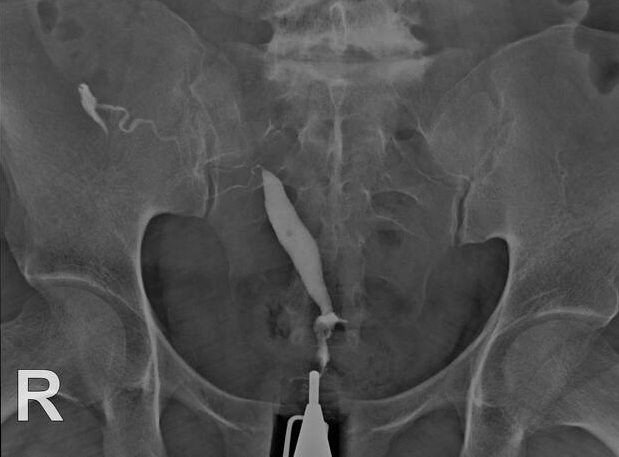
Correct Answer » C
Explanation
|
|
The most widely accepted classification system for Müllerian duct anomalies is the American Fertility Society (AFS) classification, which was later revised and is often referred to as the American Society for Reproductive Medicine (ASRM) classification. This system categorizes Müllerian duct anomalies based on specific anatomical findings
ASRM Classification of Müllerian Duct Anomalies:
Class I – Müllerian Agenesis or Hypoplasia (Mayer-Rokitansky-Küster-Hauser Syndrome):
Complete agenesis or significant hypoplasia of the uterus, cervix, and upper two-thirds of the vagina.
Class II – Unicornuate Uterus:
A uterus with one developed horn and a rudimentary or absent second horn. The rudimentary horn may or may not communicate with the main uterine cavity.
Class III – Uterus Didelphys:
Complete duplication of the uterus, cervix, and vagina, with two separate uterine cavities and no communication between them.
Class IV – Bicornuate Uterus:
Partial duplication of the uterus with a single cervix (bicornuate unicollis) or two cervices (bicornuate bicollis), characterized by a deep indentation at the top of the uterine fundus.
Class V – Septate Uterus:
A uterus that appears externally normal but has a fibrous or muscular septum dividing the internal cavity into two. This can be a complete septum extending to the cervix (complete septate) or partial septum not reaching the cervix (partial septate).
Class VI – Arcuate Uterus:
A mild form of a septate uterus with a small, concave indentation at the top of the uterine cavity.
Class VII – Diethylstilbestrol (DES) Related Anomalies:
Structural anomalies of the uterus, cervix, and vagina associated with in utero exposure to diethylstilbestrol, a synthetic estrogen.