
Metabolism of Pyrimidine
METABOLISM OF PYRIMIDINE
Biosynthesis of Pyrimidine-
- Its main site is liver.
- It takes place in cytoplasm and mitochondria organelle.
- Pyrimidine nucleotides are-
- Cytidine monophosphate (CMP)
- Uridine monophosphate (UMP)
- Thymidine monophosphate (TMP)
- Precursors for de novo synthesis of pyrimidine are.
- Glutamins provides N3
- Aspartic acid furnishes C4, C5, C6, and N1
- CO2 provides C2
- De Novo Pyrimidine Synthesis-
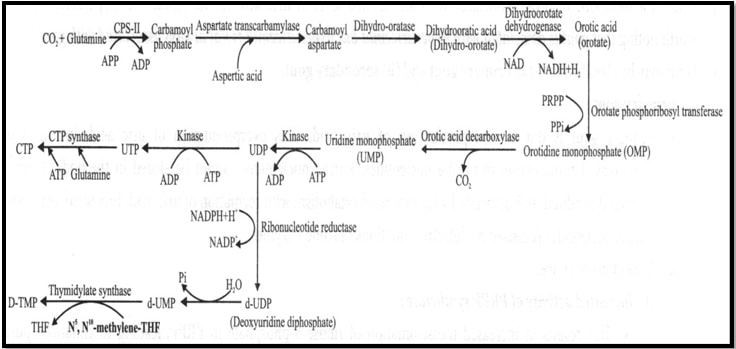
- Pyrimidine synthesis starts with the formation of carbamoyl phosphate from glutamine, ATP and CO2 and catalyzed by carbamoyl phosphate synthase- II (CPS II).
-
Enzymes of Pyrimidine synthesis-
- Carbamoyl phosphate synthase- II
- Aspartate transcarbamoylase
- DHOA dehydrogenase is the only mitochondrial enzyme.
-
Salvage of pyrimidines-
-
Pyrimidine nucleosides can be salvaged by nucleoside kinase
- Disorder of Pyrimidine Metabolism-
- Orotic aciduria
Exam Important
1. Precursors for de novo synthesis of pyrimidine are.
- Glutamins provides N3
- Aspartic acid furnishes C4, C5, C6, and N1
- CO2 provides C2
2. Aspartate transcarbamoylase catalyzes a coomitted step in pyrimidine synthesis.
3. Pyrimidines are degraded to amino acids, namely β- alanine and β- aminoisobutyrate which are then metabolized.
Don’t Forget to Solve all the previous Year Question asked on Metabolism of Pyrimidine
Click Here to Start Quiz
Click Here to Start Quiz

