
NATIONAL IMMUNISATION PROGRAMME-Introduction to VPDs, EPI :- World & India , UIP
| A | Advise to come on the fixed immunization day of the week | |
| B |
Give BCG, OPV, DPT, measles vaccines |
|
| C |
Give BCG, OPV, DPT, measles vaccines and vitamin A |
|
| D |
Give BCG, OPV, DPT and advise to come after 4 weeks for the next doses of OPV and DPT |
A 3 year old child is brought to the outpatient department with upper respiratory tract infection. On asking about his previous immunization history, it is found that he has had no primary immunizations from birth. What is the most appropriate step in the management of this patient?
| A |
Advise to come on the fixed immunization day of the week |
|
| B |
Give BCG, OPV, DPT, measles vaccines |
|
| C |
Give BCG, OPV, DPT, measles vaccines and vitamin A |
|
| D |
Give BCG, OPV, DPT and advise to come after 4 weeks for the next doses of OPV and DPT |
If a child comes with no previous immunizations, then catch-up immunizations of BCG, OPV, DPT and measles vaccines along with vitamin A must be given at the time of visit to the clinic. Advise the parents to bring the child after 4 weeks for OPV-2 and DPT-2, and after a further 4 weeks for OPV-3 and DPT-3.
Booster dose or fourth dose is given after a minimum interval of 6 months.
The fifth dose is not needed if the fourth dose was given at 4 years or older.
Ref: Ghai Essential Pediatrics, By O. P. Ghai, Piyush Gupta, V. K. Paul, 6th Edition, Page 121, 191, 200; Nelson Textbook of Pediatrics, By Kliegman, Stanton, St. Geme, Schor, Behrman, 19th Edition, Page 890.
18 month old child, has received one dose of DPT and OPV at 2 months of age. What will be your next immunization plan?
| A |
Restart immunization schedule, as per age |
|
| B |
Measles, BCG, booster dose of DPT and OPV |
|
| C |
Measles, booster dose of DPT and OPV |
|
| D |
BCG, 2nd dose of DPT and OPV |
A lapse in the immunization schedule does not require reinitiation of entire vaccine series.
| A |
50% |
|
| B |
51-60 % |
|
| C |
61-80% |
|
| D |
81-100% |
Ans. is ‘b’ i.e., 51-60%
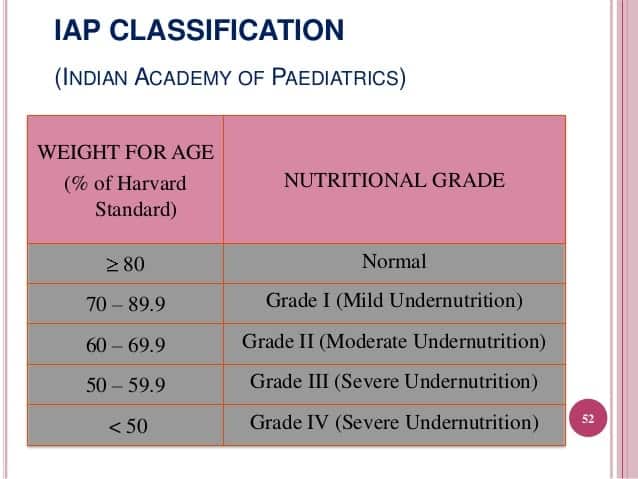
o Indian academy of pediatrics (IAP) classification of malnutrition is based on weight for age.
o IAP designates a weight of more than 80% of expected for age as normal.
o Grades of malnutrition are ‑
Grade I –> 71-80% Grade III —> 51-61%
Grade II –> 61-70% Grade IV –> 50%
| A |
Pertusis |
|
| B |
Salk vaccine |
|
| C |
Measles |
|
| D |
a and b |
Ans. is ‘a’ i.e., Pertusis; ‘b’ i.e., Salk vaccine
In national immunization shedule of India, measles vaccine is given at –
| A |
Birth |
|
| B |
6 weeks |
|
| C |
9 Months |
|
| D |
5-6 years |
Ans. is ‘c’ i.e., 9 months
- Interval between 2 doses of DPT, OPV and Hepatitis B should not be less than one month.
- Minor cough, colds and mild fever are not a contraindication to vacciation. In some states, Hepatitis B vaccine is given as routine immunization at 6th, 10th and 14th weeks.
- Vitamin A is given at 9th,18th, 24th, 30th, 36th, 42′, 48th, 54th & 60th month.
- If the child has diarrhoea, give a dose of OPV, but do not count the dose and ask the mother to return in 4 weeks for the missing dose.
Following information has been added in 22/e of Park
- New table of national immunization schedule has been added on page 115. It has schedule similar to the table mentioned above, with following additions : –
- Hepatitis B vaccine (zero dose) is also given along with OPV (zero dose) and BCG at birth.
- At 5-6 years, DPT booster is given instead of DT.
- Japanese encephalitis vaccine is given at 16-24 months with DPT/OPV.
- Now, for measles vaccination, two doses are given at 9 months and 16-24 months (Previously, only one dose vaccination used to be given at 9 months).
- Any number of vaccines (live and/or killed) can be given together
- There need not be a gap of 1 month between a live and a killed vaccine
- BCG and Measles vaccine can be given together for a case of delayed immunization
- Minor fever, diarrhea, ARI or other illness is NOT a contraindication for any of the vaccines
- Doses and schedule remain same even if baby is premature and/or underweight
In National immunization schedule all are included except-
| A | TT | |
| B | OPV | |
| C |
Hepatitis B |
|
| D |
Measles |
Ans. is ‘ c’ i.e., Hepatitis B
o TT, OPV and measles are given in National immunization schedule.
Hepatitis B vaccine has also been included in recent time.
| A | 0-12 months | |
| B |
6-12 months |
|
| C |
9-12 months |
|
| D |
12-23 months |
Ans. is ‘d’ i.e., 12-23 months
o In the Expanded programme on Immunization (EPI) cluster technique, a simplified cluster sampling method is used.
It is based on ranodm selection of 210 children who are 12-23 months of age.
These patients are selected in 30 clusters of 7 children each to estimate immunization coverage levels.
| A |
Measles vaccines |
|
| B |
Rubella vaccines |
|
| C |
BCG vaccines |
|
| D |
Diphtheria |
Ans. is ‘a’ i.e., Measles
o Amongst the respiratory tract infection, measles is related to malnutrition.
o It is related to malnutrition in both ways, i.e. –
i) Measles tends to be more severe in the malnourished child.
ii) In healthy child, measles precipitates malnutrition.
o That means measles predisposes malnutrition and vice versa.
o All cases of severe measles, and all cases of measles in areas with high case-fatality rates should be treated with vitamin A, as many children develop acute deficiency of vitamin A, which may lead to keratomalacia and blindness from corneal scarring.
o So, vitamin ‘A’ should be administred along with measles vaccine.
o A high dose of vitamin A is given immediately on diagnosis of measles and repeated the next day. The recommended age specific daily doses are 50,000 IU for infacts aged < 6 months, 100,000 IU for infants aged 6-11 months, and 200,000 IU for children aged 12 months. If the child has clinical signs of vitamin A deficiency (Such as Bitot’s spots) a third dose should be given 4-6 weeks later.
| A |
Mild |
|
| B |
Moderate |
|
| C |
Severe |
|
| D |
Normal |
Ans. is `b’ i.e., Moderate
Which vaccine is recommended at 2 years of age according to latest IAP guidelines:
| A |
MMR |
|
| B |
Pneumococcal conjugate |
|
| C |
Varicella Rubella |
|
| D |
Booster of Typhoid Conjugate Vaccine |
Ans.(d) Booster of Typhoid Conjugate Vaccine
Recommended age at which the vaccines should be received and type of vaccine:
| AGE | VACCINE |
| At Birth | Hepatitis B |
| 2 months |
|
| 4 months |
|
| 6 months |
|
| 12 months |
|
| 15 months |
|
| 18 months | Hepatitis A |
| 2 years | Booster of Typhoid Conjugate Vaccine |
| 4 to 6 years of age |
|
| 11 years of age to adult |
|
