
PHENYTOIN
Which of the following about phenytoin is true
| A |
It follows zero order kinetics |
|
| B |
Not a hepatic enzyme inducer |
|
| C |
It is excreted unchanged in urine |
|
| D |
It is not teratogenic |
Which of the following about phenytoin is true
| A |
It follows zero order kinetics |
|
| B |
Not a hepatic enzyme inducer |
|
| C |
It is excreted unchanged in urine |
|
| D |
It is not teratogenic |
It follows zero order kinetics [Ref KDT 6th/e p. 403-405J
There are three pharmacokinetic characteristic of phenytoin: –– Marked binding to serum protein
– Nonlinearity of its elimination kinetics (1t.follows saturation kinetics) – Metabolism by the CY P’S
Phenytoin follows saturation kinetics: ?
– At their therapeutic concentrations most of the drugs occupy only a small fraction of their metabolizing sites so their metabolic rate increases as the drug concentration increase.
– In such cases the metabolic rate of the drug is a constant fraction of the drug present in the body (rather than a constant amount of drug/h) i.e., the drug has a specific half life. This is.first order kinetics.
For example
If the concentration of the drug is 500 mg at time zero
– After metabolism at 1 hr the drug concentration would be -4250mg
– After metabolism at 2hr the drug concentration would be 125 mg
However
– When most of the enzymes are occupied metabolism occurs at a maximal rate i.e., it is saturated and does not change in proportion to the drug concentration i.e., a fixed amount of drug is metabolized per unit time. This is zero order kinetics.
For example
– Drug concentration at time zero —> 500 mg
– After metabolism at 1 hr —> 450 mg
– After metabolism at 2 hr —> 400 mg
- As the drug concentration increases metabolic sites and their metabolism shifts from first order to zero order.
- The drug whose kinetic changes from first order to zero at therapeutic concentration are said to follow zero?
order kinetics saturation kinetics now small increase in drug dose produces marked side effects.
– Phenvtoin is one of the few drug whose elimination varies as a function of its concentration i.e., the rate is
nonlinear, as the drug concentration increases the kinetics shift to zero order.
- Phenytoin is hydroxylated extensively in the liver and this process becomes saturated at about doses needed for therapeutic effects.
– Thus phenytoin at low doses exhibit.
– First order kinetics
– As the therapeutic concentration increases
– Zero order kinetic develops.
– Now a small increment in dose produces disproportionate rise in steady state plasma concentration. – Thus dose increments should become smaller as the dose increased.
Enzyme induction and inhibition
- We have seen above that the metabolism of phenytoin is saturable i.e., the enzymes metabolizing it gets saturated. – Because its metabolism is saturable, the other drugs that are metabolized by these enzymes can inhibit the metabolism of phenytoin and increase its concentration.
- Conversely the degradation rate of other drugs that are substrates for these enzymes can be inhibited by phenytoin.
- One such drug is warfarin
– And addition of phenytoin to a patient receiving warfarin can lead to bleeding disorders.
Another mechanism for drug interaction in phenytoin:-
- It arises from phenytoins ability to induce diverse CYPs.
-Phenytoin is a potent inducer of hepatic enzymes that metabolize other drugs.
– Coadministration of phenytoin and medication metabolized by these enzymes can lead to an increased degradation of such medication.
– Of particular note in this regard are oral contraceptive.
– Treatment with phenytoin could enhance the metabolism of oral contraceptives and lead to unplanned pregnancy. Phenytoin is highly bound to proteins (90%) mainly albumin
– Small variations in the percentage of phenytoin that is bound dramatically affect the absolute amount of free (active) drug. Therefore increased proportion of free drug are evident in Patients with hypoalbuminemia, uremic patients and neonates.
TeratoRenic effects of phenytoin
- The total plasma level decreases when the percentage that is bound decreases as in uremia or hypoalbuminemia.
- Phenytoin is metabolized to Arene oxide compound that is responsible for its teratogenic effect (Fetal hydantion syndrome) :-
– Hypoplastic phalanges
– Cleft palate
– Hair lip
– Microcephaly
Regarding phenytoin all are true except
| A |
Potent microsomal enzyme inducer |
|
| B |
Highly protein bound |
|
| C |
At lower concentration it follows zero order kinetics |
|
| D | With increasing dose, the T 1/2 increases |
At lower concentration it follows zero order kinetics [Ref. K.D.T. 6th/e p 403-405, Lawerence 9th/e p 419, 420]
- A child with respiratory infection and membrane over peritonsillar area is suspected of having Diptheria.
- Both Blood Tellurite media & Loeffler serum slope can be used for culture but Diptheria is
one emergency so the media in which it can be cultured quickly is used (Loeffler serum slope). - Loeffler serum yield colony in 6-8 hrs
- Blood Tellurite yield colony in —3 36-48 hrs
| A | Folic acid deficiency | |
| B | Biotin deficiency | |
| C | Thiamine deficiency | |
| D | Riboflavin deficiency |
| A | Used for generalised tonic clonic seizures | |
| B | Produrg | |
| C | Lipid soluble | |
| D | Highly protein bound |
| A | It acts on voltage sensitive neuronal Na., channels | |
| B | Used by slow IV injection in status epilepticus | |
| C | Kinetics change from 1st order to 0 order over therapeutic range | |
| D | It inhibits microsomal enzymes |
It inhibits microsomal enzymes
All of the following statements about Phenytoin are true, Except:
| A |
Follows saturation kinetics |
|
| B |
Is teratogenic |
|
| C |
Is highly protein bound |
|
| D |
Stimulates Insulin secretion |
Vitamin deficient is most commonly seen in a pregnant mother who is on phenytoin therapy for epilepsy?
| A |
Vitamin B6 |
|
| B |
Vitamin B12 |
|
| C |
Vitamin A |
|
| D |
Folic acid |
Phenytoin interferes with metabolism of folate and patients taking phenytoin may become deficient in folic acid.
Phenytoin decreases absorption of folic acid and increases its excretion.
Ref: Advanced Therapy in Epilepsy By Wheless, James W. Wheless, James Willmore, Roger A. Brumback, 2009, Page 259.
A lady having epileptic seizure with phenytoin therapy and become pregnant, Treatment is :
| A |
Terminate pregnancy and continue phenytoin |
|
| B |
Tapering to lowest level of phenytoin and continue pregnancy |
|
| C |
Replace phenytoin by carbamazepine |
|
| D |
Continue pregnancy with phenytoin therapy |
Ans. is b i.e. Tapering to lowest level of phenytoin and continue pregnancy
Choice ot antiepileptic drug
Drug absolutely contraindicated (in pregnancy) Valproate, Trimethadione
Drugs which should not be used unless – Phenytoin, Carbamazepine absolutely necessary
Drug of choice in epilepsy – Phenobarbitone
DOC in status epilepticus — Diazepam
So from the above text it is clear that Carbamazepine is as bad as phenytoin therefore, there is no point in replacing phenytoin with Carbamazepine
I did not get any text saying pregnancy should be terminated if patient is on phenytoin therapy, what I did get was — “Since the potential harm of uncontrolled seizures on the mother and fetus is considered greater than the teratogenic effects of antiepileptic drugs, it is currently recommended that pregnant women be maintained on effective drug therapy. When possible, it seems prudent to have the patient on monotherapy at the lowest effective dose, especially during the first trimester.
So I will go for option “b” i.e. Tapering to lowest level of phenytoin & continue pregnancy.
| A | Lymphadenopathy | |
| B |
Ataxia |
|
| C |
Hypercalcemia |
|
| D |
Hirsutism |
Ans. is ‘c’ i.e., Hypercalcemia
Phenytoin interferes with calcium metabolism by desensitizing target tissue to vit. D, this causes hypocalcemia (not hypercalcemia).
Pseudolymphoma is a manifestation of
| A |
Phenytoin |
|
| B |
Carbamazepine |
|
| C |
Sodium valproate |
|
| D |
Phenobarbital |
Ans. ‘a’ i.e., Phenytoin
- Phenytoin on long term administration can lead to lymphadenopathy which is sometimes difficult to distinguish from malignant lymphoma.
- It is known as pseudolymphoma.
| A |
It follows saturation kinetics |
|
| B |
It causes hyperglycemia |
|
| C |
It is teratogenic |
|
| D |
It does not block insulin release |
Ans. is ‘d’ i.e., It does not block insulin release
- Phenytoin inhibits insulin release which results in hyperglycemia.
- Phenytoin follows saturation kinetics i.e. at lower concentrations it has first order kinetic, whereas at higher concentrations kinetics becomes zero order due to saturation of metabolic pathways.
- Phenytoin is a known teratogen, produces fetal hydantoin syndrome.
| A |
Phenytoin |
|
| B |
Alcohol |
|
| C |
Tetracycline |
|
| D |
Sodium valproate |
Ans. is ‘a’ i.e., Phenytoin
Fetal hydantoin syndrome is characteristically associated with use of phenytoin in pregnancy.
Regarding phenytoin all are true except ‑
| A |
Potent microsomal enzyme inducer |
|
| B |
Highly protein bound |
|
| C |
At lower concentration it follows zero order kinetics |
|
| D |
With increasing dose, the VA increases. |
Ans. is ‘c’ i.e., At lower concentration it follows zero order kinetics
o The kinetics of metabolism of phenytoin is capacity limited; changes from first order to zero order over the therapeutic range, i.e., at lower concentration it follows first order kinetics and changes to zero order at higher doses. About other options
o Phenytoin is a potent enzyme inducer.
o It is 80-90% bound to plasma protein.
o T1/2 increases with dose because clearance progressively decreases as dose is increased.
| A |
Phenytoin |
|
| B |
Carbamazepine |
|
| C |
Valproic acid |
|
| D |
Phenobarbitone |
Ans. is ‘a’ i.e., Phenytoin
Phenytoin toxicity-
| A |
Gum hypertrophy |
|
| B |
Acne rosacea |
|
| C |
Exacerbation of acne vulgaris |
|
| D |
Loss of hair |
Ans. is ‘a’ i.e., Gum hypertrophy
What is not true about Fosphenytoin?
| A |
Used for GTCS |
|
| B |
Prodrug of phenytoin |
|
| C |
Lipid soluble |
|
| D |
Highly protein bound |
Ans. ‘C’ i.e., Lipid soluble
- Fosphenytoin is a water-soluble prodrug of phenytoin that has been introduced to overcome the difficulties in IV administration of phenytoin in status epilepticus.
- Fosphenytoin is cleaved into phenytoin by nonspecific phosphatases in red blood cells, liver and other tissues.
- Fosphenytoin has high plasma protein binding and it displaces phenytoin from plasma proteins, resulting in increased free phenytoin concentrations until the conversion of fosphenytoin to phenytoin is complete.
- On IV injection, fosphenytoin is less damaging to vascular intima, therefore can be injected at a faster rate.
- While phenytoin cannot be injected in a drip of glucose solution, fosphenytoin can be injected with both saline and glucose.
- Fosphenytoin is useful for adults with partial or generalized seizures when intravenous or intramuscular administration is indicated.
| A |
Can be used in absence seizures |
|
| B |
Can be mixed with saline |
|
| C |
Can be given orally |
|
| D |
It is the drug of choice for myoclonic seizures |
Ans. ‘b’ i.e., Can be mixed with saline
- While phenytoin cannot be injected in a drip of glucose solution, fosphenytoin can be injected with saline and glucose.
| A |
Phenytoin |
|
| B |
Penicillin |
|
| C |
Erythromycin |
|
| D |
a and b |
A. i.e. Phenytoin B. i.e. Penicillin
A 15 year old boy with epilepsy on treatment with combination of valproate and phenytoin has good control of seizures. Levels of both drugs are in the therapeutic range. All of the following adverse effects can be attributed to valproate except :
| A |
Weight gain of 5 kg |
|
| B |
Serum alanine aminotransaminase 150 IU/L |
|
| C |
Rise in serum ammonia level by 201.tg/dL |
|
| D |
Lymphadenopathy |
Answer is D (Lymphadenopathy):
Lymphadenopathy ‘Pseudolymphoma’ is a complication associated with use of phenytoin and is not seen with valproate.
|
Side Effects of Valproate |
Side effects of phenytoin: |
||
|
1. |
Hepatotoxicity : |
1. |
Hyperplasia of gums |
|
|
– asymptomatic rise in serum transaminases is seen-KDT |
2. |
Hyperglycemia |
|
|
– Fulminant hepatitis may be seen |
3. |
Hirsutism |
|
2. |
Weight gain |
4. |
Hypersensitivity reaction |
|
3. |
Hyper ammonemia |
5. |
Hydantoin syndrome is foetus : during pregnancy |
|
4. |
Gastric Irritation : Anorexia, vomiting |
6. |
Megaloblastic anemia |
|
5. |
Thrombocytopenia |
7. |
Osteomalacia |
|
6. |
Transient alopecia |
8. |
Lymphadenopathy – (Harrison 15th /2364) |
|
7. |
Ataxia, tremors and sedation may be seen |
|
(Pseudolymphoma) |
|
8. |
Use during pregnancy may cause neural tube defects |
9. |
Neurological symptoms like dizziness, ataxia, incordination, confusion, diplopia |
Drugs causing Lymphadenopathy –Harrison
- PhenytoinQ
- PrimidoneQ
March 2013
| A | Phenytoin | |
| B |
Carbamazepine |
|
| C |
Valproate |
|
| D |
Ethosuximide |
Ans. A i.e. Phenytoin
| A |
Is highly protein-bound |
|
| B |
Half-life decreases with decreasing dose |
|
| C |
Microsomal enzyme inducer |
|
| D |
Follows zero order kinetics at lower doses |
- Phenytoin follows saturation kinetics changes from first-order to zero order within therapeutic concentrations.
- Zero-order kinetics are seen at high doses.
- It is also a potent enzyme inducer and can increase the metabolism of various drugs.
- It is 80-90% plasma protein-bound.
Fosphenytoin route of administration ‑
| A |
Intravenous |
|
| B |
Subcutaneous |
|
| C |
Oral |
|
| D |
Intradermal |
Ans. is `a’ i.e., Intravenous
Fosphenvtoin:
- Water soluble prodrug of phenytoin
- Used in status epilepticus patients
- It is available as intravenous injection. It is less damaging to intima compared to phenytoin, can be injevted at a faster rate of 150 mg/ min, can be used in glucose solution drip.
- Its infusion requires ECG monitoring.
| A | Lymphadenopathy | |
| B |
Ataxia |
|
| C |
Hypercalcemia |
|
| D |
Hirsutism |
Ans. is ‘c’ i.e., Hypercalcemia
- Phenytoin interferes with calcium metabolism by desensitizing target tissue to vit. D, this causes hypocalcemia (not hypercalcemia).
- At therapeutic level (10-20microg/ml) – Gum hypertrophy, hirsutism, hypersensitivity (rashes, lymphadenopathy, DLE, neutropenia), hyperglycemia due to inhibition of insulin release, megaloblastic anemia, pseudolymphoma, hypocalcemia, Vitamin D deficiency and osteomalacia, and teratogenicity (fetal hydantoin syndrome).
- At toxic level (dose-related) cerebellar syndrome (ataxia, vertigo), falling BP, arrhythmias, drowsiness, mental confusion, Gl symptoms (epigastric pain, nausea, vomiting) and local vascular injury by iv injection.
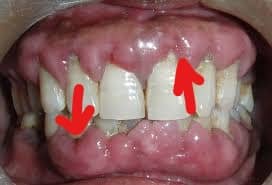
| A |
Phenytoin. |
|
| B |
Carbamazepine. |
|
| C |
Valproic acid. |
|
| D |
Propranolol |
The condition shown in the picture above represents gingival hyperplasia.
Gingival enlargement(also termed gingival overgrowth, hypertrophic gingivitis, gingival hyperplasia, or gingival hypertrophy)
- It is an increase in the size of the gingiva (gums).
- A closely related term is epulis, denoting a localized tumor (i.e. lump) on the gingiva.
Gingival enlargement has been classified according to cause into 5 general groups:
Inflammatory enlargement:
- Gingivitis
- Accumulation and retention of plaque is the chief cause .
- Risk factors include poor oral hygiene, as well as physical irritation of the gingiva by improper restorative and orthodontic appliances.
Drug induced enlargement
- anticonvulsants (such as phenytoin, phenobarbital, lamotrigine, vigabatrin, ethosuximide, topiramate and primidone )
- calcium channel blockers (antihypertensives such as nifedipine, amlodipine, and verapamil)
- cyclosporine, an immunosuppresant.
- Of all cases , about 50% are attributed to phenytoin, 30% to cyclosporins and the remaining 10-20% to calcium channel blockers.
Enlargement associated with systemic diseases or conditions
- pregnancy
- puberty
- vitamin C deficiency
- nonspecific, such as a pyogenic granuloma
- granulolomatous diseases, such as granulomatosis with polyangiitis, sarcoidosis, or orofacial granulomatosis
Neoplastic enlargement
- leukemia
- benign neoplasms, such as fibromas, papillomas and giant cell granulomas
- malignant neoplasms, such as a carcinoma or malignant melanoma
False enlargement.
- such as when there is an underlying bony or dental tissue lesion.
Treatment:
- The first line management of gingival overgrowth is improved oral hygiene, ensuring that the irritative plaque is removed from around the necks of the teeth and gum.
- Gingivectomy:Situations in which the chronic inflammatory gingival enlargement include significant fibrotic components.
Exanthema is caused by which drug ‑
| A |
Phenytoin |
|
| B |
Valproate |
|
| C |
Digoxin |
|
| D |
NTG |
Ans. is ‘a’ i.e., Phenytoin
In the metabolism of alcohol, high doses of aspirin& phenytoin, mechanism is –
| A |
First pass kinetics |
|
| B |
First order kinetics |
|
| C |
Zero order kinetics |
|
| D |
Second order kinetics |
Ans. is ‘c’ i.e., Zero order kinetics
