
POSTERIOR TRIANGLE OF NECK
TRIANGLES OF NECK
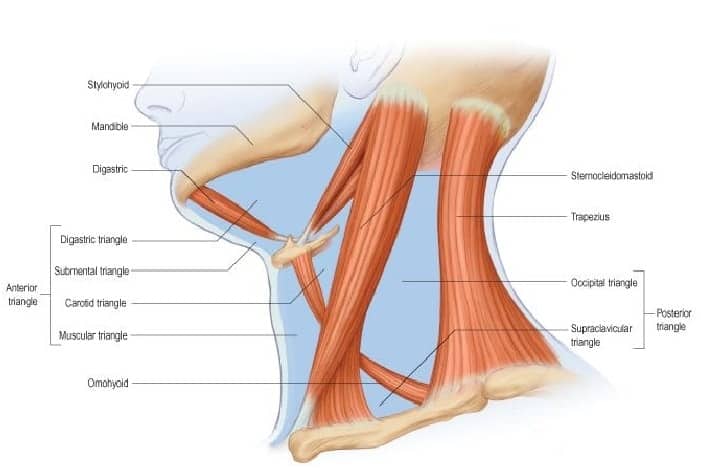
- Anterolateral aspect (side) of neck is divided by sternocleidomastoid muscle into:
- Anterior triangle in front of the muscle &
- Posterior triangle, behind the muscle.
POSTERIOR TRIANGLE OF NECK
- Posterior triangle is situated behind sternocleidomastoid muscle.
- Anterior border is formed by posterior border of sternocleidomastoid.
- Posterior border is formed by anterior margin of trapezius.
- Base is formed by superior surface of middle third of clavicle.
- Apex lies on superior nuchal line at junction of trapezius & sternocleidomastoid.
- Roof is formed by investing layer of deep cervical fascia, skin & superficial fascia.
- Floor is formed by prevertebral layer of deep cervical fascia covering following muscles:
- splenius capitis
- levator scapulae
- scalenus medius &
- semispinalis capitis
- Posterior triangle is subdivided into:
- larger upper occipital triangle &
- smaller lower supraclavicular (subclavian) triangle by inferior belly of omohyoid.
|
CONTENTS OF THE POSTERIOR TRIANGLE |
||
| CONTENTS |
OCCIPITAL TRIANGLE |
SUBCLAVIAN TRIANGLE |
|
NERVES |
1. Spinal accessory nerve
2. Four cutaneous branches of cervical plexus:
3. Muscular branches
4. C5, C6 roots of the brachial plexus
|
|
|
VESSELS |
|
|
|
LYMPH NODES |
|
|
- Spinal accessory nerve (XI cranial nerve) runs along the levator scapulae to supply trapezius.
- Because it lies close to the roof, the nerve may be damaged by a lacerating injury or during incision & drainage of abscess in posterior triangle causing paralysis of trapezius which results in drooping of shoulder & difficulty in overhead abduction & diffficulty in shrugging of shoulder.
SUBOCCIPITAL TRIANGLE
- Lies more deeply in upper part of back of neck just below the occipital bone.
- It is bounded by:
- Superomedially: rectus capitis posterior major & minor
- Superolaterally: Obliques capitis superior
- Inferolaterally: Obliques capitis inferior
- Floor is formed by posterior atlantooccipital membrane & posterior arch of atlas.
- Its contents are:
- 3rd part of vertebral artery
- suboccipital nerve (dorsal ramus of C1)
- Suboccipital venous plexus.
Exam Important
- The omohyoid muscle is an important landmark in both the anterior and posterior triangles of the neck.
- Base of the posterior triangle of neck is formed by superior surface of middle third of clavicle.
- Superficial incision on posterior triangle of neck leads to difficulty in shrugging of shoulder.
- Contents of Suboccipital triangle are:
- 3rd part of vertebral artery
- suboccipital nerve (dorsal ramus of C1)
- Suboccipital venous plexus.
Don’t Forget to Solve all the previous Year Question asked on POSTERIOR TRIANGLE OF NECK
Click Here to Start Quiz
Click Here to Start Quiz

