
PRIMITIVE REFLEXES
| A | Normal child | |
| B | Brain damage | |
| C | Irritable child | |
| D | Hungry child |
| A | Normal child | |
| B | Brain damage | |
| C | Irritable child | |
| D | Hungry child |
MORO REFLEX is also known as embrace reflex or startle reflex. It is a reflex seen in infants in response to stimuli, e.g. that produced by suddenly striking the surface on which the infant rests. To elicit this reflex the head is momentarily allowed to fall back and then is re supported by the examiner’s hand. The child symmetrically abducts and extends the arms, flexes the thumbs. This movement is followed by flexion and adduction of upper extremities. Persistence of Moro’s reflex beyond 12 weeks indicates neurological damage.
Examination of a 6-hour-old infant delivered with difficulty by low forceps reveals an asymmetric Moro reflex involving the right arm. Infant is cyanotic and has labored respiration. Abdomen does not bulge with inspiration, and there are decreased breath sounds in the right chest. Most likely diagnosis is?
| A |
Respiratory distress syndrome |
|
| B |
Meconium aspiration syndrome |
|
| C |
Ipsilateral paralysis of the diaphragm |
|
| D |
Tracheoesophageal fistula |
Ans:C.)Ipsilateral paralysis of the diaphragm .
- Phrenic nerve injury with ipsilateral diaphragmatic paralysis must be suspected in this infant.
- The abdomen does not bulge with the breathing is mostly thoracic.
- Diagnosis is made during fluoroscopy, Respiratory distress syndrome is more seen in preterm infants and presents with cyanosis, tachypnea and grunting respirations.
- The mother usually has a history of difficult delivery.
- Chest x-ray reveals a ground-glass appearance. Meconium aspiration syndrome appears at birth, usually in term or post-term infants.
- There is a history of meconium-stained amniotic fluid. When meconium is aspirated into the lungs, respiratory distress may occur within the first hours of life.
- Overdistention of the chest may be present. Meconium aspiration syndrome is not associated with an asymmetric Moro reflex.
- Tracheoesophageal fistula presents as choking and cyanosis with feeding.
- It should be suspected in cases of maternal polyhydramnios, or excessive oral secretions of the infant.
- Choanal atresia is suspected in a cyanotic newborn who becomes pink on crying, and the diagnosis is made by failure to pass a catheter through the nasal passages.
| A | The sequence and time of attainment of milestones may vary among individual children | |
| B | Development always proceeds in a cephalocaudal sequence | |
| C | Presence of primitive reflexes is essential for attaining voluntary actions | |
| D | All of the above |
Which of the following developmental reflexes does NOT disappear in a child?
| A |
Landau reflex |
|
| B |
Palmar grasp |
|
| C |
Tonic neck reflex |
|
| D |
Parachute reflex |
The age of appearance of some reflexes are given below:
A two month old child is able to –
| A |
Show a positive parachute protective reflex |
|
| B |
Hold head steady in seated position |
|
| C |
Lift head and chest of a flat surface with extended elbow |
|
| D |
Sustain head level with the body when placed in ventral suspension |
Ans. is ‘d’ i.e., Sustain head level with the body when placed in ventral suspension Important mile stones of a 2 months child.
- In ventral suspension, lifts his head in the horizontal plane (in the plane of the body).
- Social smile develops
- Follow object with steady movement of eye.
About other options
o Parachute reflex develops during 9th month of life
o Control of head develops by 3 months
o A child can lift head and chest off a flat surface with extended elbow by 6 months.
| A |
Normal child |
|
| B |
Brain damage |
|
| C |
Hungry child |
|
| D |
Irritable child |
Ans. is ‘b’ i.e., Brain damage
Parachute reflex disappear at –
| A |
3 months |
|
| B |
6 months |
|
| C |
9 months |
|
| D |
Never |
Ans. is ‘d’ i.e., Never
Important primitive reflexes
| Reflex | Age of appearance | Age of disappearance (after birth) |
|
o Rooting
o Moro o Palmar grasp o Assymmetic tonic neck o Symmetric tonic neck o Landau o Parachute |
32 wks of gestation
28-32 wks of gestation 28 wks of gestation 35 wks of gestation 4-6 months 10 months 8-9 months |
Less prominent after 1 month
3-6 months 2-3 months 6-7 months 8-12 months 24 months remain throughout life 1-2 months |
Remember : Earliest reflex to disappear Rooting reflex.
Age of appearance
Child of 9 months, which reflex is most abnormal ‑
| A |
Asymmetric neck reflex |
|
| B |
Parachute reflex |
|
| C |
Righting reflex |
|
| D |
None |
Ans. is ‘a’ i.e., Asymmetric neck reflex
o Asymmetric tonic neck reflex is prominant between 2nd and 4th months.
o Persistence of this reflex beyond the age of 6 – 9 months or a constant tonic neck posture are abnormal and usually indicate spastic cerebral palsy.

| A |
Tonic neck reflex |
|
| B |
Moro’s reflex |
|
| C |
Parachute reflex |
|
| D |
Rooting reflex |
Ans:B.)Moro’s reflex.
Neonatal reflexes
- A number of primitive neonatal reflexes can be elicited in healthy term neonate.
- These disappear as the child grows —> These reflexes are inhibited by frontal lobes as child grows. Absence of reflex responses indicates dysfunction of central or peripheral motor function.
- Abnormal persistence of neonatal reflexes is pathognomonic of central motor lesions.
A. Reflexes present at birth
Rooting, sucking & swallowing reflexes
- The rooting reflex : disappears around four months of age
- A newborn infant will turn its head toward anything that strokes its cheek or mouth, searching for the object by moving its head.
- The sucking reflex: It causes the child to instinctively suck anything that touches the roof of their mouth, and simulates the way a child naturally eats.
The walking or stepping reflex
- When the soles of their feet touch a flat surface they will attempt to walk by placing one foot in front of the other.This reflex disappears at six weeks
Crossed extensor
- The crossed extensor reflex is a withdrawal reflex.
- When the bottom of the foot is held and flicked, the baby will flex,adduct and then extend the opposite leg and appear to try to push the object away.
Moro reflex
- This is sometimes referred to as the startle reaction, startle response, startle reflex or embrace reflex.
- The Moro reflex is present at birth, peaks in the first month of life, and normally disappears by three to four months of age
- It is likely to occur if the infant’s head suddenly shifts position, the temperature changes abruptly, or they are startled by a sudden noise.
- Consists of rapid abduction and extension of arms with the opening of hands,tensing the back muscles,flexion of legs and crying.
Assymmetric tonic neck reflex
- The asymmetrical tonic neck reflex, also known as ‘fencing posture’, is present at one month of age and disappears at around four months. When the child’s head is turned to the side, the arm on that side will straighten and the opposite arm will bend .
Palmar grasp (grasp reflex)
- The palmar grasp reflex appears at birth and persists until five or six months of age.
- When an object is placed in the infant’s hand and strokes their palm, the fingers will close and they will grasp it with a palmar grasp.
Plantar reflex
- Trigger: A gentle stroke on the sole of the foot (from heel to toe)
- Response: Foot turns in and toes flare up
- Appears at birth and lasts until baby is 6 to 24 months old
B. Reflexes appear after birth
Symmetric tonic neck
- The symmetric tonic neck reflex normally appears and develops around 6-9 months of age and should integrate by around 12 months.
- When the child’s head flexes forward, extending the back of the neck, the upper extremities will contract and the lower extremities will extend.
- Conversely, when the child’s head is extended backward, contracting the back of the neck, the upper extremities will extend and the lower extremities will contract.
Parachute reflex
- This occurs from about 9 months of age and persists.
- If the baby is held in a position where he is dropped forward, he will outstretch his hands. This is one of the baby milestones that is protective for falling.
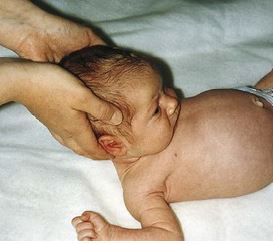
| A |
Moro reflex. |
|
| B |
Grasp reflex. |
|
| C |
Galant’s infantile reflex. |
|
| D |
None. |
- The Moro reflex, as shown in the picture above evaluates vestibular maturation and the relationship between flexor and extensor tone.
- Elicitation of the reflex involves a short (10 cm), sudden drop of the head when the infant is supine.
- The full response involves extension of the arms, “fanning” of the fingers, and then upper extremity flexion followed by a cry.
- An incomplete but identifiable reflex becomes apparent at approximately 32 weeks’ gestation, and by 38 weeks it is essentially complete.
- Very immature infants demonstrate extension of the arms and fingers but do not show true flexion or make a sustained cry.
- Marked asymmetry of response may be associated with focal neurologic impairment.
Reflex used in neonate as shown in the photograph below is ?

| A |
Moro’s reflex. |
|
| B |
Rooting reflex. |
|
| C |
Parachute reflex. |
|
| D |
None of the above. |
A reflex that is seen in normal newborn babies, who automatically turn the face toward the stimulus and make sucking (rooting) motions with the mouth when the cheek or lip is touched. The rooting reflex helps to ensure successful breastfeeding.
