
Pulled elbow
A 4 year boy complaining of pain around elbow which is held in pronation with extension and normal X ray. What is the probable diagnosis?
| A | Pulled elbow | |
| B | Montegia fracture | |
| C | Cellulitis | |
| D | None of the above |
A 4 year boy complaining of pain around elbow which is held in pronation with extension and normal X ray. What is the probable diagnosis?
| A | Pulled elbow | |
| B | Montegia fracture | |
| C | Cellulitis | |
| D | None of the above |
Pulled elbow
REF: Apley’s 8th ed p. 603
Nursemaid’s elbow, Babysitter’s elbow or Pulled elbow is a dislocation of the elbow joint caused by a sudden pull on the extended pronated arm, such as by an adult tugging on an uncooperative child, or swinging the child by the arms during play. The technical term for the injury is radial head subluxation.
Common in children below 5 years of age
The child stops using the arm, which is held flexed and pronated.
- Minimal swelling.
- All movements are permitted except supination.
- The child cries inconsolably
Treatment:
The affected arm must be held by the attending physician with one hand/finger on the radial head and the other grasping the hand. While applying compression between these two hands, the forearm of the patient is gently supinated and the arm flexed. The physician will usually feel a “click” if the maneuver is done properly, the child will feel momentary pain, and usually within 5 minutes, the forearm will thereafter function well and painlessly.
| A | Pulled elbow | |
| B |
Montegia fracture |
|
| C |
Cellulitis |
|
| D |
None of the above |
Pulled elbow or Nursemaid elbow or Babysitter’s elbow or radial head subluxation is most commonly occurs in children aged 1-4 years.
The etiology is slippage of the head of the radius under the annular ligament. The distal attachment of the annular ligament covering the radial head is weaker in children than in adults, allowing it to be more easily torn.
As children age, the annular ligament strengthens, making the condition less common. The oval shape of the proximal radius in cross-section contributes to this condition by offering a more acute angle posteriorly and laterally, with less resistance to slippage of the ligament when axial traction is applied to the extended and pronated forearm. The patient resists supination/pronation as well as flexion/extension of the forearm.
Axial traction is the most common cause of nursemaid elbow. A fall is the second most common mechanism of injury. Infants have been reported with nursemaid elbow after rolling over or being assisted to roll over.
The Monteggia fracture is a fracture of the proximal third of the ulna with dislocation of the head of the radius.
A child is spinned around by holding his hand by his father. While doing this the child started crying and does not allow his father to touch his elbow. The diagnosis is:
| A |
Pulled elbow |
|
| B |
Radial head dislocation |
|
| C |
Annular ligament tear |
|
| D |
Fracture olecranon process |
A child is spinned around by holding his hand by his father. While doing this the child started crying and does not allow his father to touch his elbow. The diagnosis is :
| A |
Pulled elbow |
|
| B |
Radial head dislocation |
|
| C |
Annular ligament tear |
|
| D |
Fracture olecranon process |
A i.e. Pulled elbow
Pulled Elbow is:
| A |
Disarticulation of elbow |
|
| B |
Disarticulation of elbow |
|
| C |
Subluxation of proximal radio ulnar joint |
|
| D |
None of the above |
C i.e. subluxation of proximal radio ulnar joint
- If a young child is lifted by the wrist, the head of the radius may be pulled partly out of the annular ligament, i.e., subluxation of the head of the radius.
It occurs when forearm is pronated, elbow is extended and longitudinal traction is applied to the hand or wrist, e.g., lifting, spinning or swinging a child with wrist or hand. Pulled elbow most commonly occurs between the age of 2-5 years
Pulled elbow is
| A |
A sprain of extensor tendons |
|
| B |
Dislocation of head of radius |
|
| C |
Fracture of lateral condyle of humerus |
|
| D |
Dislocation of elbow |
B i.e. Dislocation of head
A 30 years old male comes to ortho emergency with his 3 years old daughter who is crying. The father gives the history of child being swung by forearm. The most probable diagnosis is:
| A |
Supracondylar humerus fracture |
|
| B |
Elbow dislocation |
|
| C |
Stress fracture |
|
| D |
Pulled elbow |
D i.e. Pulled elbow
What is not true about pulled elbow?
| A |
Occurs due to sudden axial pull on extended elbow |
|
| B |
Forearm is held in pronation and extention |
|
| C |
Most commonly occurs between 2-5 years of age |
|
| D |
Treatment is quick pronation and flexion of elbow |
Ans. is ‘d’ i.e., Treatment is quick pronation and flexion of elbow
Pulled elbow
- If a young child is lifted by the wrist, the head of the radius may be pulled partly out of the annular ligament, i.e., subluxation of the head of the radius.
- It occurs when forearm is pronated, elbow is extended and longitudinal traction is applied to the hand or wrist, e.g., lifting, spinning or swinging a child with wrist or hand. Pulled elbow most commonly occurs between the age of 2-5 years.
Clinical features of pulled elbow
- History of sudden axial pull on extended elbow.
- Immediately child starts crying and is unable to move the affected elbow.
- The forearm is held in pronation and extension and any attempt to supinate is resisted.
- Child does not allow to touch the affected limb.
- X-ray seems to be normal.
Treatment of pulled elbow
- Treatment is simple. The child’s attention is diverted, the elbow is quickly supinated and then slightly flexed.
- This reduces the subluxation or dislocation and the radial head is relocated with a snap.
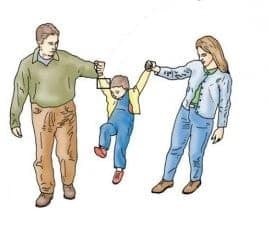
| A |
Fracture of Capitellum. |
|
| B |
Radial head fracture. |
|
| C |
Radial head fracture. |
|
| D |
Pulled elbow. |
Mechanism shown in the photograph above generally lead to Pulled elbow.
A 2-year old child is spinned around by his father holding his hand. Suddenly the child started crying and did not allow his father to touch his elbow. Which of the following is the likely diagnosis?
| A |
Pulled elbow |
|
| B |
Supracondylar fracture |
|
| C |
Fracture olecranon process |
|
| D |
Radial head dislocation |
Ans. a. Pulled elbow
