
REABSORPTION & SECRETION OF PROXIMAL TUBULE
* In proximal tubule, GFR & volume reduces to one-third.
– 60%-70% GFR reabsorbed.
– Both filtered solute & water.
* Solutes concentraion remains unchanged (As in GF).
* Fluid out of proximal tubule is isotonic with GR & plasma.
PROXIMAL REABSORPTION – OBLIGATORY TYPE:
* Due to 2 reasons,
– Independent of fluid & electrolyte status of body.
– Independent of hormonal control.
* Hence, “Obligatory reabsorption”.
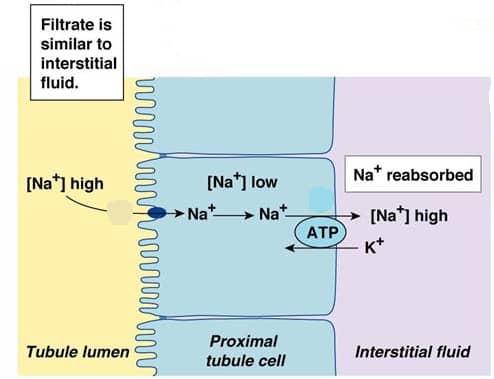
* First mechanism activated in proximal tubule.
– Driven by Na2+-K+-ATPase located on basolateral membrane.
* Most other resorptions are secondary to Na2+ active transport.
1. PASSIVE Cl– REABSORPTION:
* Due to trans-epithelial potential difference development.
2. WATER REABSORPTION:
* 60-70% of filtered water reabsorbed passively.
– Because of osmosis.
– Occurs through water channel aquaporin-1.
* Coupled mainly to sodium reabsorption.
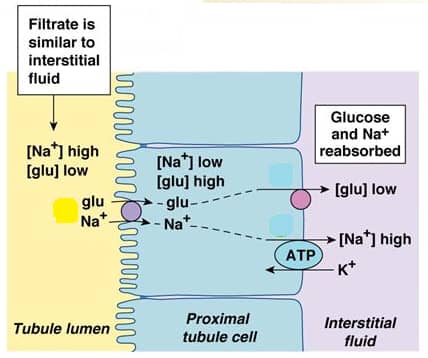
3. GLUCOSE REABSORPTION:
* Absorbed completely (100%).
* Occurs by Na2+-Glucose cotransporter-1 (SGLT -1)
– Located in luminal membrane (brush border).
4. AMINO ACID REABSORPTION:
* Completely absorbed (100%).
* By sodium-amino acid cotransporter.
5. PHOSPHATE REABSORPTION:
* Co-transports with sodium.
6. HYDROGEN ION:
* H+ ions – Secreted into tubular fluid.
– By secondary active transport (antiport/countertransport).
– Mainly Na2+–H+ exchanger.
7. BICARBONATE REABSORPTION:
* Maximum (90%) bicarbonate absorption.
* H+ ions secretion by Na2+-H+ exchanger couples bicarbonate reabsorption.
8. OTHER REABSORPTION:
* 2/3rd filtered K+ reabsorbed in PCT.
* 40-50% urea reabsorbed.
* Glucose, amino acids & bicarbonate – Reabsorbed from filtrate in early/first part of PCT.
* Creatinine – Completely unabsorbed.
Exam Important
* GFR & its volume is reduced to 1/3rd (About 60-70% reabsorbed) in proximal tubule.
* Fluid out of proximal tubule is isotonic with GR & plasma.
* Primary active step for sodium reabsorption in proximal tubule involves Na+-K+-ATPase at baso-lateral membrane.
* About 60-70% of water reabsorbed in proximal tubules because of osmosis through aquaporin-1 channel.
* Passive water reabsorption is coupled mainly to sodium reabsorption.
* Glucose is absorbed completely (100%) in proximal tubule by Na2+-Glucose cotransporter-1 (SGLT -1) in luminal membrane & by glucose transporter GLUT-1 in basolateral membrane.
* Amino acids are completely reabsorbed in proximal tubules.
* H+ ions secreted into tubular fluid is mainly by Na2+-H+ exchanger.
* Phosphate reabsorption occurs along with sodium co-transport.
* Maximum (90%) bicarbonate absorption in proximal tubules is coupled with H+ ions secretion by Na2+-H+ exchanger.
* About 40-50% of urea reabsorbed.
* Glucose, amino acids, & bicarbonate are reabsorbed along with Na+ in early portion of proximal tubule.
Click Here to Start Quiz

