
REFRACTIVE SYSTEM OF EYE
| A | Anterior surface of lens | |
| B | Post surface of lens | |
| C | Cornea | |
| D | Centre of lens |
| A | Anterior surface of lens | |
| B | Post surface of lens | |
| C | Cornea | |
| D | Centre of lens |
Centre of lens
What is the refractive power of cornea?
| A |
15 |
|
| B |
30 |
|
| C |
43 |
|
| D |
60 |
Refractive power of eye can be changed by:
| A |
Radial keratotomy |
|
| B |
Keratomileusis |
|
| C |
IOL |
|
| D |
All |
A i.e. Radial keratotomy; B i.e Keratomileusis; C i.e. IOL
The refractive power of an emmetropic eye is about:
| A |
+50D |
|
| B |
+55D |
|
| C |
+60D |
|
| D |
+65D |
Ans. +60D
In the media of the eye, highest refractive index is of the:
| A |
Cornea |
|
| B |
Aqueous humour |
|
| C |
Lens |
|
| D |
Vitreous humour |
Ans. Lens
The term anisometropia indicates
| A |
Refractive error |
|
| B |
Long vision |
|
| C |
Short vision |
|
| D |
Ageing process |
Ans. Refractive error
1mm change in the axial length of the eyeball produces a change in refractive index by:
March 2005
| A |
1 D |
|
| B |
2 D |
|
| C |
3 D |
|
| D |
4 D |
Ans. C: 3D
1mm change in the axial length of the eyeball produces a change in refractive index by 3 D. Elongation produces myopia and shortening causes hypermetropia.
1 mm change in the radius of curvature of the cornea produces a 6 D refractive change.
Steeper (more curved) corneas produce myopia and flatter corneas hypermetropia.
March 2007
| A |
Anterior surface of lens |
|
| B |
Posterior surface of lens |
|
| C |
Anterior surface of cornea |
|
| D |
Posterior surface of cornea |
Ans. C: Anterior surface of cornea
Together with the lens, the cornea refracts light, accounting for approximately two-thirds of the eye’s total optical power. In humans, the refractive power of the cornea is approximately 43 dioptres.
While the cornea contributes most of the eye’s focusing power, its focus is fixed.
The curvature of the lens, on the other hand, can be adjusted to “tune” the focus depending upon the object’s distance.
September 2007
| A |
+6 D |
|
| B |
+10 D |
|
| C |
+16D |
|
| D |
+60 D |
Ans. D: +60 D
The power of the front surface of the cornea is about 43D, and, if it were in air, the power of the crystalline lens at rest (its minimum power, not accommodating) would be about 20D.
This adds up to 63D.
But the ‘schematic’ eye is said to have 60 D of power: a little power is lost when the ray exits the cornea into aqueous, since this means it is going from a material with higher index to a material of lower index.
September 2007
| A | 1.28 | |
| B |
1.38 |
|
| C |
1.48 |
|
| D |
1.58 |
Ans. B: 1.38
It is the first and most important refracting surface of the eye, having a power of about 43 D.
The anterior surface has a radius of curvature of about 7.8 m, the posterior surface 6.5 mm, and the central thickness is about 0.5 mm.
Cornea is comprised of several layers and, therefore, the optical properties are measured for the whole cornea rather than generalizing from a tissue sample.
| A | Cornea | |
| B |
Air |
|
| C |
Lens |
|
| D |
Vitreous |
Ans. is ‘c’ i.e., Lens
- Refractive index of various eye parts
- Cornea-1.376
- Aqueous humor-1.336
- Lens(from cortex to core)-1.386-1.406
- Vitreous humor-1.336
- How to memorise!
a. The refractive index depends upon the optical density
- Aqueous and vitreous being fluids have low density-have low refractive index.
- Cornea is less optically dense than lens.(cornea is thinner than lens!)
b. So remember 4 values
- i. 1.336-aqueous/vitreous
- ii. 1.376-cornea
- iii. 1.386-cortex of lens
- iv. 1.406-core or centroid of lens
c. Also remember,the refractive index of the anterior surface of lens is greater than the posterior surface.
Refractive index of vitreous humor ‑
| A |
1 |
|
| B |
1-30 |
|
| C |
14 |
|
| D |
1.336 |
Ans. is ‘d’ i.e., 1.336
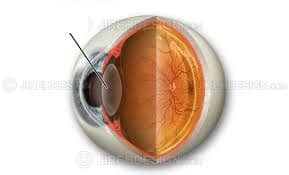
Refractive index of this structure marked with arrow is about:
| A |
1.000 |
|
| B |
1.330 |
|
| C |
1.400 |
|
| D |
1.370 |
Ans:C.)1.400.
This structure is crystalline lens
Light rays reflecting from distant objects are focused on the retina after they passed through the cornea, aqueous humor, the lens, and finally the vitreous humor.
The refractive index of human lens varies from approximately 1.406 in the central layers down to 1.386 in less dense layers of the lens
| Medium | Refractive Index |
|---|---|
| Air | 1.000 |
| Cornea | 1.376 |
| Aqueous Humor | 1.336 |
| Lens | 1.406 |
| Vitreous Humor | 1.336 |
