
RETINOPATHY OF PREMATURITY
RETINOPATHY OF PREMATURITY (ROM)

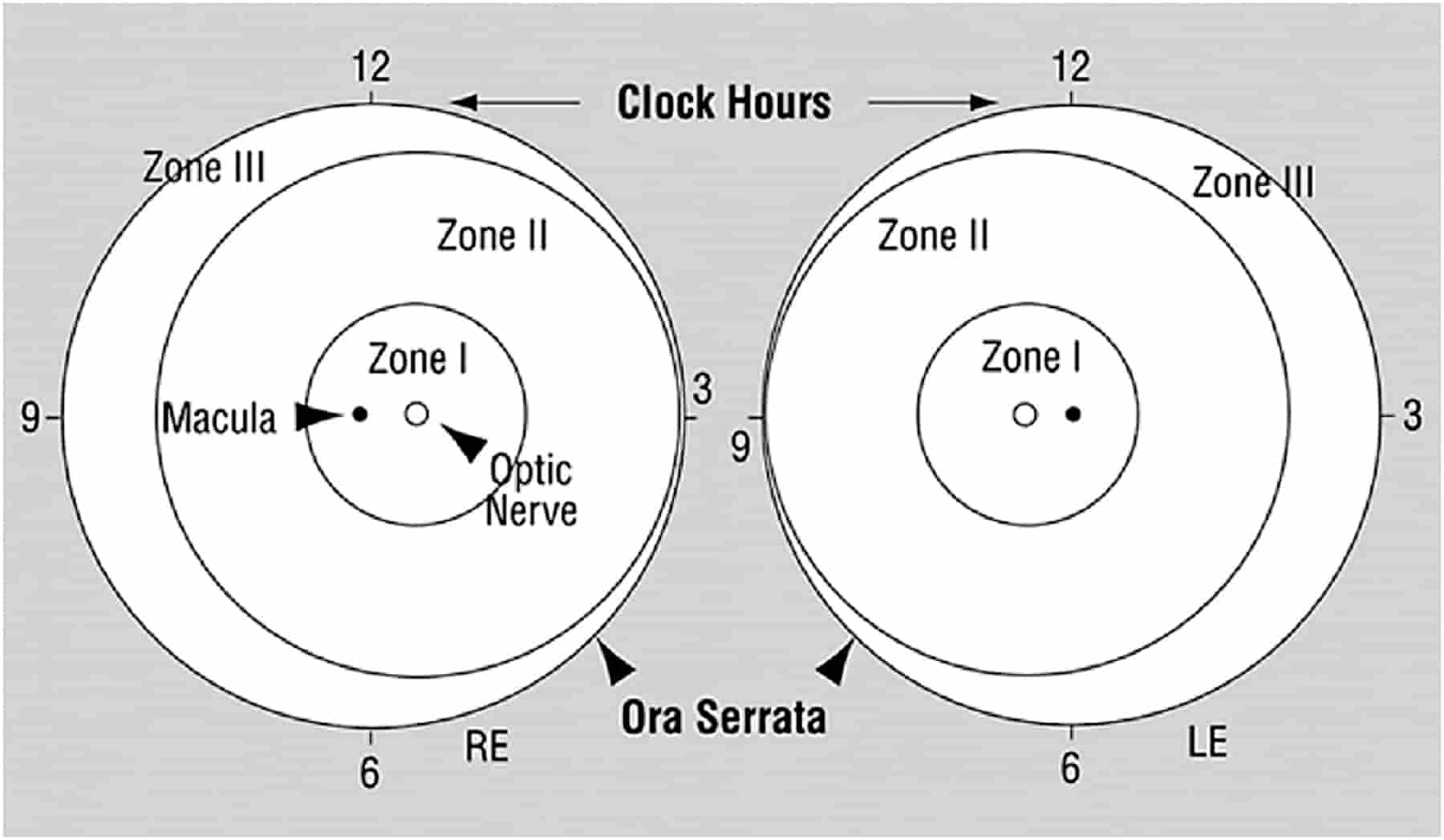

- Also k/a RETROLENTAL FIBROPLASIA.
- Affects retinal vasculature of premature babies.
- Retinal manifestations are noted some weeks after birth in premature infants who have been given high concentration of Oxygen.
- Confined to those with a birth weight of under 1.5 kg & gestational age 32 weeks.
- All babies weighing less than 1500 gm or having a gestational period of less than 32 weeks should be screened with indirect ophthalmoscopy for ROM, b/w 32 & 36 weeks post conception.
Important risk factors
1. Primary-
- Prematurity: Gestation age
- Birth weight< 1.5 kg
-
- Oxygen therapy: Excessive oxygen use
2. Other-
- Sepsis
- multiple blood transfusions
- Metabolic acidosis
Importnant signs
- Leukoplakia (white pupil)
- Nystagmus (abnormal eye movements)
- Strabismus (crossed eye)
- Severe nearsightedness (myopia)
Classification of ROP
I. O/B of severity, ROP divided into 5 stages:
- Stage 1: appearance of a thin, flat, white structure at the junction of vascularised retina posteriorly & avascular retina anteriorly
- Stage 2: the demarcation line develops into a pink ir white elevation (ridge) of thickened tissue.
- Stage 3: proliferation of vessels over the ridge & into vitreous (extravitreal fibrovascular proliferation)
- Stage 4: partial retinal detachment
- 4a- partial detachment with macular sparing
- 4b- partial detachment with macula involved
- Stage 5: total retinal detachment
II. O/B of anatomical location:
- 3 zones are divided to describe the location of ROP.
- Location of border in zone 1 is the most severe disease & in zone 3 least.
i) Zone 1:
- Defined as a circle, the center of which is the disc.
- Radius of which is twice the distance of the disc of the fovea.
ii) Zone 2
- Doughnut- shaped region
- Extends from the anterior border of zone 1 to within one disc-diameter of the ora serrata nasally & the anatomic equator temporarally.
iii) Zone 3 encompasses the residual temporal retina.
PLUS DISEASE:
- As ROP progresses, more & more shunting occurs in the neovascular tissue at the retinal vascular-avascular junction.
- This increased retinal vascular blood flow results in:
- dilation & tortuosity of the major retinal arteries & veins in the posterior pole- described as “plus disease”.
- Plus disease is the hallmark of rapidly progressive ROP
- Denoted by adding a plus sign after the number of the ROP stage.
MANAGEMENT
- Most of the cases (approx. 80%) of ROP resolve spontaneously.
- ROP is divided into threshold & prethreshold disease.
1. Threshold disease:
- Defined as a stage 3+ ROP in zones 1 or 2
- Occupying at least 5 contaguous clock-hours or eight noncontagious clock-hours of retina.
- Treatment of threshold disease is -Laser photocoagulation.
2. Prethreshold disease: divided into 2 types:
- High risk or Type I- treatment is Laser photocoagulation
- Low risk or Type II- treatment is Weekly or twice weekly observation.
| TYPE I Prethreshold | TYPE II Prethreshold |
|
Zone I ROP (any stage)+
Zone II, Stage 3 Zone II, Stage2/3+ |
Zone I, Stage ½ –
Zone II, Stage 3- |
| Laser photocoagulation | Weekly or twice observation |
Exam Important
- Retinopathy of prematurity is commonly predisposed by Less gestation age.
- For preventing Retinopathy of Prematurity, concentration of oxygen should be 50-60%.
- Stage 3 of ROP shows a ridge with retinal fibrovascular proliferation and neovasularisation.
- Plus disease is the hallmark of rapidly progressive ROP.
Don’t Forget to Solve all the previous Year Question asked on RETINOPATHY OF PREMATURITY
Click Here to Start Quiz
Click Here to Start Quiz

