
RHINOSPORIDIOSIS
RHINOSPORIDIOSIS
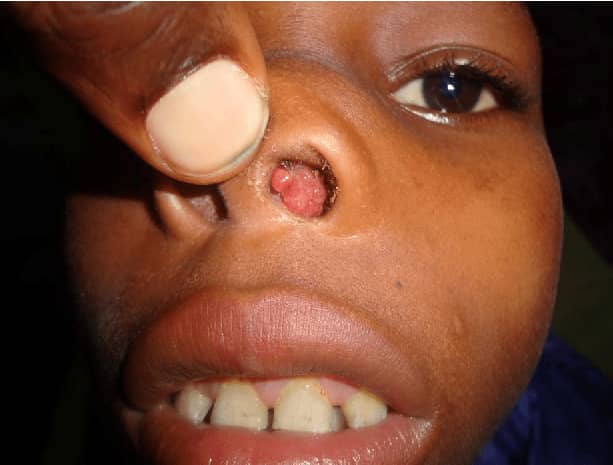
- Rhinosporidiosis is a chronic granulomatous infection of the mucous membranes.
- Manifests as vascular friable polyps that arise from the nasal mucosa or external structures of the eye.
- It is endemic in India and Sri Lanka.
CAUSE OF RHINOSPORIDIOSIS
- The etiologic agent is R seeberi.
- Rhinosporidium seeberi is an aquatic bacterium (not a fungus).
- Recent RNA gene analysis has placed R seeberi into a novel group of aquatic parasites of the class Mesomycetozoea.
- Most persons with rhinosporidiosis have had bathing or working exposure to stagnant water.
Although traditionally regarded as a fungus, it is now considered a protistan parasite belonging to the class Mesomycetozoea.
CLINICAL FEATURES
- Rhinosporidiosis is an infection that is typically limited to the mucosal epithelium.
- Sex: Men are affected more commonly than women, with a male-to-female ratio of 4:1.Age:The disease most commonly occurs in children and in individuals aged 15-40 years.
- Infection of the nose and nasopharynx is observed in 70% of persons with rhinosporidiosis.
- Infection of the palpebral conjunctivae or associated structures (including the lacrimal apparatus) is observed in 15%.
- Nasal disease may present with unilateral nasal obstruction or epistaxis.
Other symptoms may include :
- local pruritus, coryza with sneezing, rhinorrhea, and postnasal discharge (drip) with cough.
- Patients often report a sensation that a foreign body is present in their nasal canal.
- Eye involvement is initially asymptomatic.
- Increased tearing may be reported as the disease progresses.
- Photophobia, redness, and secondary infection may occur.
Soft polyps may develop on the nose or eye.
- These polyps are pink to deep red, are sessile or pedunculated, and are often described as strawberrylike in appearance.
- This appearance results from sporangia, which is visible as gray or yellow spots in the vascular polypoid masses.
- Because the polyps of rhinosporidiosis are vascular and friable, they bleed easily upon manipulation.
TREATMENT
- Rhinosporidiosis is treated with surgical excision.C
- Complete excision of mass is done with diathermy knife & cauterization of base.
- Dapsone has been tried with some success.
Exam Important
- Rhinosporidiosis presents as a nasal polypoidal mass.
- Rhinosporidiosis presnts as a fungal granuloma.
- The etiologic agent of rhinosporidiosis, R seeberi, has traditionally been considered a fungus.
- Recent RNA gene analysis has placed R seeberi into a novel group of aquatic parasites .
- Surgery is the treatment in a case of Rhinosporidiosis.
Don’t Forget to Solve all the previous Year Question asked on RHINOSPORIDIOSIS
Click Here to Start Quiz
Click Here to Start Quiz

