
Sampling
SAMPLING:
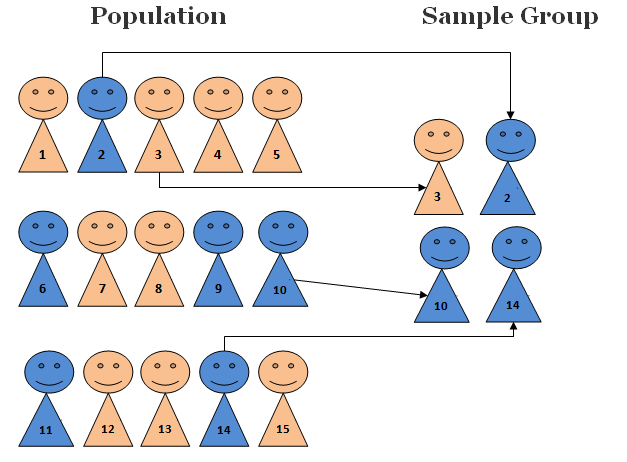
- The process of selecting a number of individuals for a study in such a way that the individuals represent the larger group from which they were selected.
PURPOSE:
- To gather data about the population in order to make an inference that can be generalized to the population
STAGES IN SAMPLE SELECTION:
- Define the target population
- Select a sampling frame
- Conduct fieldwork
- Determine if a probability or nonprobability sampling method will be chosen
- Plan procedure for selecting sampling units
- Determine sample size Select actual sampling units
QUANTITATIVE SAMPLING:
- Purpose – to identify participants from whom to seek some information
- Issues :
- Nature of the sample (random samples)
- Size of the sample
- Method of selecting the sample
- Representation – the extent to which the sample is representative of the population
- Generalization – the extent to which the results of the study can be reasonably extended from the sample to the population
- Sampling error :The chance occurrence that a randomly selected sample is not representative of the population due to errors inherent in the sampling technique
- TYPES:
- Probability samples
- Non – probability samples
PROBABILITY SAMPLING SELECTION:
Four techniques
- Random
- Stratified random
- Cluster
- Systematic
SIMPLE RANDOM SAMPLING:
- Selecting subjects so that all members of a population have an equal and independent chance of being selected.
- Ideal for homogenous population
- Advantages
- Easy to conduct
- High probability of achieving a representative sample
- Meets assumptions of many statistical procedures
- Disadvantages :
- Identification of all members of the population can be difficult
- Contacting all members of the sample can be difficult
STRATIFIED RANDOM SAMPLING:
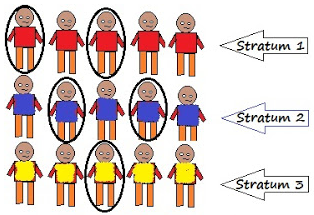
- The population is divided into two or more groups called strata, according to some criterion, such as geographic location, grade level, age, or income, and subsamples are randomly selected from each strata.
- Samples are taken according to a predetermined periodicity.
- Advantages
- More accurate sample
- Can be used for both proportional and nonproportional samples
- Representation of subgroups in the sample
- Disadvantages
- Identification of all members of the population can be difficult
- Identifying members of all subgroups can be difficult
CLUSTER SAMPLING:
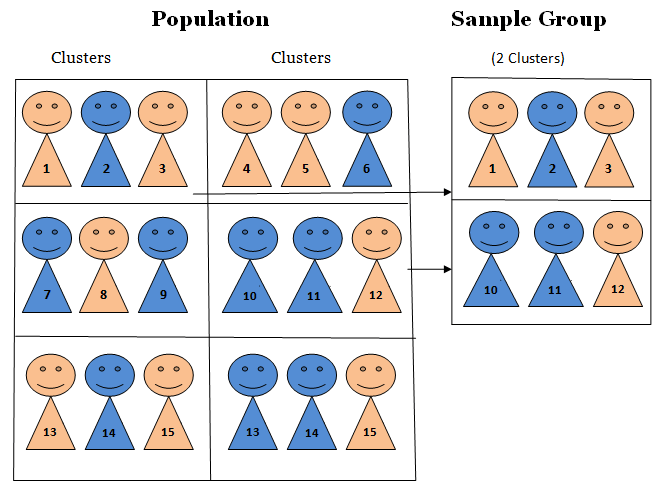
- The process of randomly selecting intact groups, not individuals, within the defined population sharing similar characteristics
- The sample size may vary according to study design.
- Examples :
- Neighborhoods
- School districts
- Schools
- Classrooms
- Advantages
- Very useful when populations are large and spread over a large geographic region
- Convenient and expedient
- Do not need the names of everyone in the population
- Rapid and simple method
- Disadvantages
- Representation is likely to become an issue
- Higher sampling error
SYSTEMATIC SAMPLING:
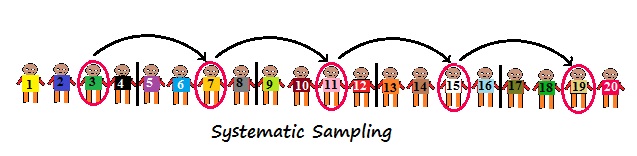
- Selecting every Kth subject from a list of the members of the population
- Advantage
- Very easily done
- Disadvantages
- Subgroups
- Some members of the population don’t have an equal chance of being included
NON-PROBABLITY SAMPLE:
- Random: allows a procedure governed by chance to select the sample; controls for sampling bias.
- Non-random:
- Convenience sampling:
- Whoever happens to be available at the time called “accidental” or “haphazard” sampling
- Disadvantage:Difficulty in determining how much of the effect results from the cause
- Whoever happens to be available at the time called “accidental” or “haphazard” sampling
- Purposive sampling:
- Researcher selects a sample based on experience or knowledge of the group to be sampled called “judgment” sampling
- Disadvantge:Potential for inaccuracy in the researcher’s criteria and resulting sample selections
- Quota sampling:
- Researcher gathers data from individuals possessing identified characteristics and quotas
- Disdvantage:people who are less accessible are under-represented
QUALITATIVE SAMPLING:
- Researchers in qualitative research select their participants according to their :
- Characteristics
- Knowledge
The Purposeful Sampling:
- It is when the researcher chooses persons or sites which provide specific knowledge about the topic of the study.
- TYPES:
- Maximal Variation Sampling :
- Selection of individuals that differ on a certain characteristic.
- Typical Sampling:
- Study of a person or a site that is “typical” to those unfamiliar with the situation.
- Study of a person or a site that is “typical” to those unfamiliar with the situation.
- Theory or Concept Sampling :
- Selection of individuals or sites if they can help to generate a theory or specific concepts within the theory.
- Homogeneous Sampling:
- Selection of certain sites or people because they possess similar characteristics
- Critical Sampling:
- When studing an exceptional case represents the central phenomenon in dramatic terms
- Opportunistic Sampling:
- It is used after data collection begins, when one find that what needed to be collected new information to answer research questions
- Snowball Sampling:
- Done when the best people to study is unknown because of the unfamiliarity of the topic or the complexity of events
- Maximal Variation Sampling :
Exam Important
- Simple random sampling is ideal for Homogenous population
- For a survey a village is divided into 5 lanes then each lane is sampled randomly is an example is Stratified random sampling
- Cluster sampling is a two stage sampling
- Cluster sampling is probability sample
- The sample size may vary according to study design in cluster sampling
- Cluster sampling is Rapid and simple method
- Cluster sampling is cheaper than other methods of sampling
- Cluster sampling has the disadvantage of higher sampling error
- Snowball sampling is used for hidden population
- The method in which the sample is taken from each predefined strata of society is called Stratified sampling
- Systematic observation and recording of activities of individuals carried out at predetermined or random intervals is known as Work sampling
- Simple Random Sampling Every element in the population has an equal probability of being included
- Sampling error is classified as Alpha error and Beta error
- Simple random, Cluster sampling & Stratified random are random sampling methods
- In random sampling chance of being picked up is Same and known
- Sampling method used in assessing immunization status of children under immunization programme is Cluster sampling
- Quota sampling & Convenience Sampling are non-random sampling methods
- In stratified random sampling population is divided into strata
Don’t Forget to Solve all the previous Year Question asked on Sampling
Click Here to Start Quiz
Click Here to Start Quiz

