
SUBMANDIBULAR GLAND
SUBMANDIBULAR GLAND
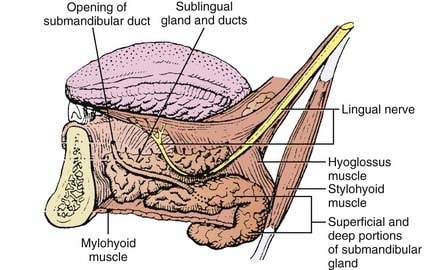
- Mixed type of salivary gland (mucous & serous acini).
- Predominantly serous in nature.
- Walnut sized gland lies below the mandible in the anterior part of digastric triangle.
- J-shaped and consists of a large superficial and a small deep parts.
- Separated by mylohyoid muscle & continuous with each other around the posterior border of mylohyoid muscle.
Superficial part:
- Situated in the anterior part of digastric triangle.
- Gland is partially closed in a capsule formed by two layers of deep cervical fascia.
Has three surfaces:
- Inferior surface is covered by skin, platysma, cervical branch of facial nerve, dep fascia, facial vein and submandibular lymph nodes.
- Lateral surface is related to submandibular fossa (on mandible), medial pterygoid (insertion) and facial artery.
- Medial surface is related to mylohyoid, hyoglossus and styloglossus muscles.
Deep part:
- Lies on the hyoglossus muscle deep to mylohyoid.
- Related above to lingual nerve, submandibular ganglion; and below to hypoglossal nerve.
Submandibular duct (Wharton’s duct)
- 5 cm long duct and runs forwards on hyoglossus, b/w lingual and hypoglossal nerves.
- At the anterior border of the hyoglossus muscle crossed by lingual nerve which loops around it.
- Opens into the floor of mouth, on the summit of the sublingual papilla at the side of frenulum of tongue.
BLOOD SUPPLY:
- Arterial supply is by- branches of facial & lingual arteries.
- Venous drainage- by common facial & lingual veins.
- Lymphatic drainage- Submandibular lymph nodes.
NERVE SUPPLY:
- Secretomotor supply is same for submandibular and sublingual salivary glands, through the submandibular ganglion.
- Preganglionic fibers arise from superior salivatory nucleus, and pass successively via sensory root of VII nerve (nerve intermedius)→ facial nerve → chorda tympani nerve → lingual nerve → submandibular gland → postganglionic fibers → submandibular & lingual glands.
Exam Important
- Lobes of submandibular gland are divided by Mylohyoid muscle.
- Preganglionic fibers to the submandibular gland arise from superior salivatory nucleus.
- Nerve which loop around submandibular duct is Lingual nerve.
- Structure not injured in submandibular gland excision is Inferior alveolar nerve.
- In Submandibular gland surgery the nerve leastlikely to be injured is Inferior alveolar nerve.
Don’t Forget to Solve all the previous Year Question asked on SUBMANDIBULAR GLAND
Click Here to Start Quiz
Click Here to Start Quiz

