
Supercoiling of DNA
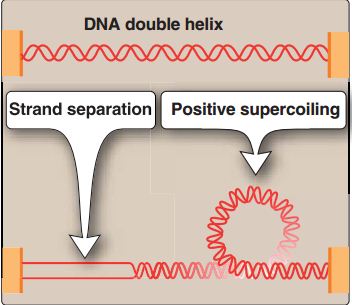
- Supercoiling can be demonstrated by tightly grasping one end of a helical telephone cord while twisting the other end
- As the two strands of the double helix are separated, a problem is encountered, namely, the appearance of positive supercoils (also called supertwists).
Functions of Supercoils:
- Supercoiling promotes packing of DNA into compact structures
- Helps to generate regions with broken hydrogen bonds which facilitate DNA strand separation and
- facilitate replication, repair and recombination of the DNA .
- If the cord is twisted in the direction of tightening the coils, the cord will wrap around itself in space to form positive supercoils.
- If the cord is twisted in the direction of loosening the coils, the cord will wrap around itself in the opposite direction to form negative supercoils.
Enzymes called DNA topoisomerases, which are responsible for removing supercoils in the helix.

Topoisomerase functions:
- Nicking Resealing Enzyme
- Enzymes that can relax or insert supercoils
- Enzymes that relieve torsional strains in the DNA.
Topoisomerases can be of two types: Type I and Type II
Topoisomerase Type I
- These enzymes reversibly cut one strand of the double helix. They have both nuclease (strand-cutting) and ligase (strand-resealing) activities.
- They do not require ATP, but store energy from the phosphodiester bond they cleave, reusing the energy to reseal the strand.
- Each time a transient “nick” is created in one DNA strand.
- Type I topoisomerase relax negative supercoils.
Topoisomerase Type II
- These enzymes bind tightly to the DNA double helix and make transient breaks in both strands.
- The enzyme then causes a second stretch of the DNA double helix to pass through the break and, finally, reseals the break.
- both negative and positive supercoils can be relieved by this ATP-requiring process.
- DNA gyrase, a Type II topoisomerase found in bacteria and plants.
- Type II DNA topoisomerases are also required in both prokaryotes and eukaryotes for the separation of interlocked molecules of DNA.
Anticancer agents, such as etoposide, target human topoisomerase II
Bacterial DNA gyrase is a unique target of a group of anti microbial agents called quinolones, for example, ciprofloxacin
Exam Important
Don’t Forget to Solve all the previous Year Question asked on Supercoiling of DNA
Click Here to Start Quiz
Click Here to Start Quiz

