
THALAMUS
- Two ovoid masses of grey matter lying close together rostrally.
- Is a collection of neurons organized into large number of well-defined nuclear masses.
– Joined by mass intermedia in midline.
– Separated only by third ventricle.
THALAMIC NUCLEI:
DIVISIONS:
1. Medial nuclear mass
- Intra-laminar nuclei.
- Centro-median nucleus.
- Dorsomedial nucleus.
- Midline nuclei.
- Medial geniculate body.
- Reticular nuclei.
2. Lateral nuclear mass.
- 2 Subtypes.
2a. Dorsal/Lateral group.
- Lateral dorsal
- Lateral posterior
- Pulvinar
- Lateral geniculate body.
2b. Ventral group:
- Ventral anterior.
- Ventral lateral.
- Ventral posterior –
– Ventro-Posterior Lateral (VPL) &
– Ventro-Posterior Medial (VPM).
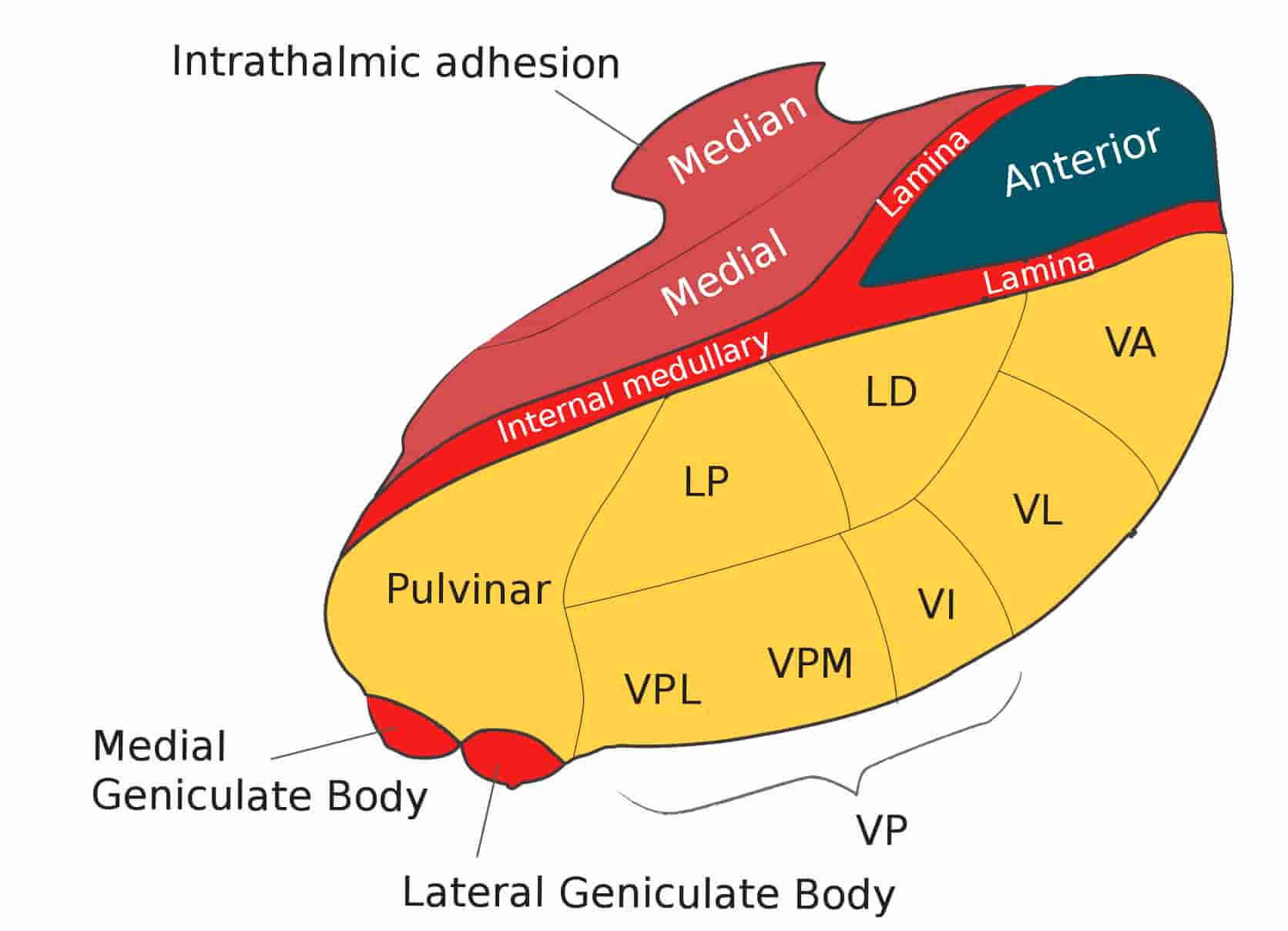
FUNCTIONAL DIVISION OF NUCLEI:
- Divided into 4 groups.
| GROUP | Description | Nuclei Involved |
| Specific sensory nuclei |
|
|
| Association nuclei |
|
|
| Nonspecific nuclei |
|
|
| Motor nuclei |
|
|
FUNCTIONS OF THALAMUS:
1. Acts as “Sensory Relay Station” for all sensory pathways.
- Includes Gustatory & Olfactory tracts reaching cortex.
- Modulates sensory information relayed.
- Determines conscious awareness for sensations.
2. Integrative center –
- Connects many brain areas.
- Including cerebral cortex, basal ganglia, hypothalamus & brain stem.
- Ascending sensory fibers pass through brainstem –> Synapse in thalamus –> Relay on cerebral cortex via internal capsule.
- Doesn’t synapse in thalamus.
4. Concerned with conscious interpretation of crude touch, pain & temperature.
- Final discrimination of sensory modalities occurs in sensory cortex after thalamus provides information.
5. Integrates motor activities information from cerebellum & globus pallidus with premotor cortex.
- By VA & VL thalamic nuclei.
6. Important for visual-attention & visually-guided movements-
- By Pulvinar nuclei.
7. Modulates brain wave synchronization & de-synchronization.
- Influences attention & consciousness.
- Done by Reticular nucleus
8. Role in emotions & memory –
- Due to relay station in Papez circuit.
9. Acts as “Single functional entity” with cortex.
- “Thalamo-Cortical” system.
- Prepares crude blueprint of final product achieved by cortex.
10. Output of reticular nuclei – Mainly to thalamic nuclei.
- Every thalamic nuclei sends output to different cortical areas.
Exam Important
- Acts as “Sensory Relay Station” for all sensory pathways, includes Gustatory & Olfactory tracts reaching cortex.
- Concerned with conscious interpretation of crude touch, pain & temperature.
- Every thalamic nuclei sends output to different cortical areas.
- Motor thalamic nuclei relay & process messages from basal ganglia & cerebellum to motor & premotor cortex.
– Mainly by Ventral anterior nuclei.
- Specific sensory nuclei receives all sensory afferents from ascending pathways projecting to somato-sensory cortex.
– Mainly by Ventro-posterior nuclei.
Click Here to Start Quiz

