
Thyroglossal Cyst
THYROGLOSSAL CYST

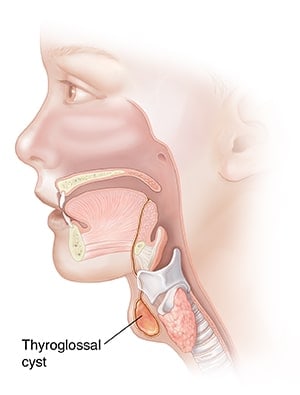

- It is congenital in origin.
- It is cystic swelling developed in the remnant of the thyroglossal duct or tract.
CLINICAL FEATURES OF THYROGLOSSAL CYST
- Site – It may be present in any part of the thyroglossal tract (thyroglossal tract extends from foramen caecum to the isthmus of thyroid).
- Hyoid bone is closely associated with Thyroglossal cyst/fistula.
Common sites are:
- Subhyoid (most common) in the region of the thyroid cartilages,
- Suprahyoid in the floor of mouth
- Beneath the foramen caecum
- It is a painless midline swelling, except in the region of the thyroid cartilage, where the thyroglossal tract is pushed to one side, usually to the left.Though its a congenital swelling most common age of presentation is between 2 to 4 yrs.
- It is located within 2 cm of the midline.
- Mobility – Cyst can be moved sideways but not vertically
- Peculiar characterstic which helps in distinguishing thyroglossal cyst from other neck swelling – it moves up with protrusion of tongue as the thyroglossal tract is attached to the tongue.
- It also moves with deglutition so do all thyroid swellings, subhyoid bursitis, sublingual dermoid.
- Cyst is lined by pseudostratified columnar epithelium and squamous epithelium with hetrotopic thyroid tissue present in 20% of cases.
COMPLICATIONS OF THYROGLOSSAL CYST
- Recurrent infection
- Formation of thyroglossal fistula.Carcinomatous change (usually Papillary carcinoma.)
- Thyroglossal cyst is congenital but thyroglossal fistula is never congenital. It follows infection or inadequate removal of a thyroglossal cyst.
TREATMENT OF THYROGOLSSAL CYST
- Excision of the thyroglossal cyst along with the track and the central part of body of the hyoid bone is the treatment of choice (Sistrunk’s operation)
Exam Important
- Most common site of thyroglossal cyst is Subhyoid.
- Thyroglossal cyst moves upwards on protrusion of tongue.
- Thyroglossal cyst is located within 2 cm of the midline.
- Thyroglossal cyst is the frequent cause of anterior midline neck masses in the first decade of life.
- Excision of the thyroglossal cyst along with the track and the body of the hyoid bone is the treatment of choice (Sistrunk’s operation)
- The most common site of a swelling in a 16 year old girl presenting with a painless swelling in the midline of the neck and moves up and down with swallowing and with protrusion of the tongue is Subhyoid.
- The cause of swelling in a child presenting with a midline swelling beneath the arch of the hyoid bone might be Thyroglossal cyst.
- In thyroglossal cyst, Papillary carcinoma may arise.
- Thyroglossal cyst is an example of painless midline swelling.
- Hyoid bone is closely associated with Thyroglossal cyst/fistula.
- In the management of thyroglossal cyst,Central portion of hyoid excised.
- Sistrunk’s operation is used in Thyroglossal fistula and Thyroglossal cyst.
- Thyroglossal cyst move on deglutition(other causes are pre-tracheal lymph nose and thyroid nodule).
- Thyroglossal fistula develops due to Incomplete removal or infection of thyroglossal cyst
Don’t Forget to Solve all the previous Year Question asked on Thyroglossal Cyst
Click Here to Start Quiz
Click Here to Start Quiz

