
THYROID OPTHALMOPATHY
THYROID OPHTHALMOPATHY (DISTHYROID OPHTHALMOPATHY)

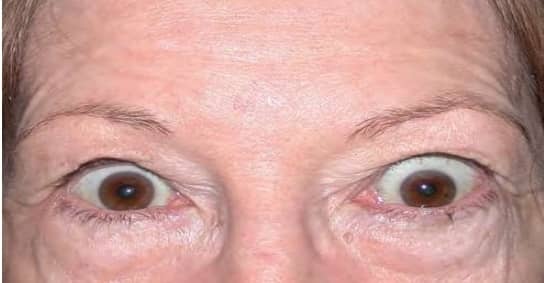

- Thyroid ophthalmopathy, also c/d thyroid orbitopathy, is a disease of the orbit seen in Graves disease (thyrotoxicosis), therefore also c/d Graves ophthalmopathy.
- Characterised by enlargement of ocular flat & enlargement of extraocular muscles due to deposition of mucopolysaccharides.
Clinical features are:
- The most common & earliest symptom is upper eyelid retraction.
- Exopthalmos (Proptosis): Proptosis is the second most common symptom.
- Thyroid ophthalmopathy is the m/c cause of proptosis, whether unilateral or bilateral in adults.
Proptosis may be:
- Mild exopthalmos: in hyperthyroids (thyrotoxicosis, Graves disease)
- Extreme exoptalmos: in hypothyroidism
- Restrictive extraocular myopathy: Enlargement of extraocular muscle without enlargement of tendon is the hallmark of thyroid ophtalmopathy.
- Inferior rectus muscle (m/c involved).
- External ophtalmoplegia: Thyroid ophthalmopathy can cause vertical diplopia due to paralysis of vertical acting muscles like inferior oblique.
Ocular signs are:
- Bilateral exopthalmos with assoiated exposure keratitis
- Kocher’s sign: Staring & frightened appearance, especially marked on attentive fixation.
- Dalrymple’s sign: There is peculiar stare due to retraction of upper lid
- Von Graefe’s sign: Upper lid lags on downwards movements of the eyeball
- Stellwag’s sign: infrequent & incomplete blinking
- Mobius sign: there is weakness of convergence
- Jellinek’s sign: there is increased pigmentation of lids.
- Joffroy’s sign: there is poor forehead wrinking on looking up
- Enroth’s sign: fullness of eyelids (Puffy edematous)
- Grifford’s sign: Difficulty in eversion of upper lid.
Exam Important
- The walls of the orbit which are removed in the two wall decompression for proptosis of thyroid ophthalmopathy include part of Orbital floor and medial wall
- Occurrence of diplopia, dysphagia, dysarthria, blurring of vision and muscle weakness could be due to Botulism
- Muscle mostly affected in thyroid ophthalmopathy is Inferior rectus
- Earliest symptom of thyroid ophthalmopathy is Lid retraction
- Most common cause of proptosis in adults is Thyroid Ophthalmopathy
- Sign of thyroid ophthalmopathy are Van Graefe’s sign , Dalrymple’s sign & Joffroy’s sing
- Most common ocular movement affected in thyroid ophthalmopathy Elevation
Don’t Forget to Solve all the previous Year Question asked on THYROID OPTHALMOPATHY
Click Here to Start Quiz
Click Here to Start Quiz

