TUBERCULOSIS OF KNEE

TUBERCULOSIS OF KNEE


TUBERCULOSIS OF THE KNEE

  • The knee is a common site of tuberculosis.

CLINICAL FEATURES

  1. Age group of 10-25 years.
  2. Pain and swelling in the knee.
  3. Severe stiffness of the knee.

EXAMINATION

  • Following findings may be present on examination:
  1. Swelling
  2. Muscle atrophy
  3. Cold abscess
  4. Sinus
  5. Mild flexion deformity of the knee because of effusion in the knee, and muscle spasm.
  6. Pain and muscle spasm on attempting movement.
INVESTIGATIONS
Radiological examination:
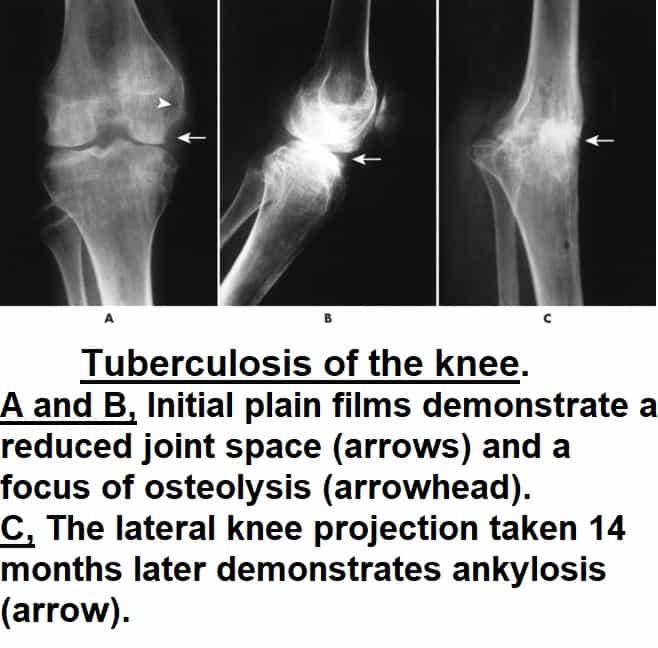
  • The joint space may be widened.
  • There is diffuse osteoporosis of the bones around the joint.
  • In osseous tuberculosis, may see juxta-articular lytic lesions.
  • The joint surfaces may be eroded.
  • In later stages, joint space may be diminished or completely lost.
  • In advanced stages, triple subluxation with cavitatory bone lesions may be present.

Other investigations: Biopsy required.

TREATMENT

Conservative treatment:

  • antitubercular chemotherapy.
  • general care and local care of the part affected. 
  • Surgery taken if indicated.
  • Care of the knee: The knee is rested by applying below-knee skin traction or an above-knee PoP slab.

Operative treatment:

  • Synovectomy
  • Joint debridement
  • Arthrodesis

Exam Important

TUBERCULOSIS OF KNEE

Radiological examination:

  • The joint space may be widened.
  • There is diffuse osteoporosis of the bones around the joint.
  • In osseous tuberculosis, may see juxta-articular lytic lesions.
  • The joint surfaces may be eroded.
  • In later stages, joint space may be diminished or completely lost.
  • In advanced stages, triple subluxation with cavitatory bone lesions may be present.
Don’t Forget to Solve all the previous Year Question asked on TUBERCULOSIS OF KNEE
Click Here to Start Quiz

Module Below Start Quiz

Leave a Reply

TUBERCULOSIS OF KNEE

TUBERCULOSIS OF KNEE


TUBERCULOSIS OF THE KNEE

  • The knee is a common site of tuberculosis.

CLINICAL FEATURES

  1. Age group of 10-25 years.
  2. Pain and swelling in the knee.
  3. Severe stiffness of the knee.

EXAMINATION

  • Following findings may be present on examination:
  1. Swelling
  2. Muscle atrophy
  3. Cold abscess
  4. Sinus
  5. Mild flexion deformity of the knee because of effusion in the knee, and muscle spasm.
  6. Pain and muscle spasm on attempting movement.
INVESTIGATIONS
Radiological examination:

  • The joint space may be widened.
  • There is diffuse osteoporosis of the bones around the joint.
  • In osseous tuberculosis, may see juxta-articular lytic lesions.
  • The joint surfaces may be eroded.
  • In later stages, joint space may be diminished or completely lost.
  • In advanced stages, triple subluxation with cavitatory bone lesions may be present.

Other investigations: Biopsy required.

TREATMENT

Conservative treatment:

  • antitubercular chemotherapy.
  • general care and local care of the part affected. 
  • Surgery taken if indicated.
  • Care of the knee: The knee is rested by applying below-knee skin traction or an above-knee PoP slab.

Operative treatment:

  • Synovectomy
  • Joint debridement
  • Arthrodesis

Exam Important

TUBERCULOSIS OF KNEE

Radiological examination:

  • The joint space may be widened.
  • There is diffuse osteoporosis of the bones around the joint.
  • In osseous tuberculosis, may see juxta-articular lytic lesions.
  • The joint surfaces may be eroded.
  • In later stages, joint space may be diminished or completely lost.
  • In advanced stages, triple subluxation with cavitatory bone lesions may be present.
Don’t Forget to Solve all the previous Year Question asked on TUBERCULOSIS OF KNEE
Click Here to Start Quiz

Module Below Start Quiz

Leave a Reply

Discover more from New

Subscribe now to keep reading and get access to the full archive.

Continue reading

👨‍⚕️
Chat Support