
TYPE II HYPERSENSITIVITY
| A | Hemorrhagic disease of newborn | |
| B |
Graves disease |
|
| C |
Autoimmune disease |
|
| D |
Hemolytic anemia |
All are type-II hypersensitivity reaction except ‑
| A |
Hemorrhagic disease of newborn |
|
| B |
Graves disease |
|
| C |
Autoimmune disease |
|
| D |
Hemolytic anemia |
Ans. is ‘a’ i.e., Hemorrhagic disease of newborn
- Graves disease, Autoimmune hemolytic anemia are type II hypersensitivity reactions.
- Hemorrhagic disease of newborn is due to vitamin K deficiency.
| A |
Type I |
|
| B |
Type II |
|
| C |
Type III |
|
| D |
Type IV |
Ans. is ‘b’ i.e., Type II
Has been explained
Type II hypersensitivity is mediated by ‑
| A |
Immune complex |
|
| B |
IgG |
|
| C |
Ig M |
|
| D |
A and C |
Ans. is ‘a’ i.e., Immune complex; ‘c’ i.e., Ig M
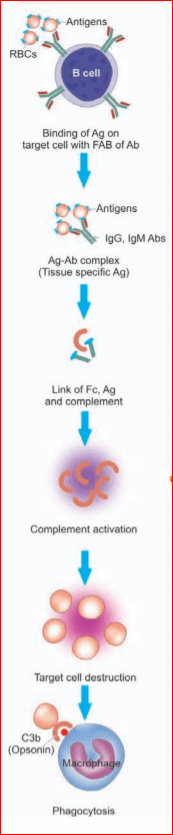
o Type II hypersensitivity reaction involves Ig G or Ig M antibodies bound to cell surface antigen, with subsequent complement fixation.
Type II hypersensitivity reaction (Antibody mediated)
o Mediated by antibodies directed toward antigen on cell surfaces or extracellular matrix.
o Three different antibody-dependent mechanisms involved in this type of reaction.
1. Opsonization and complement and Fc receptor-mediated phagocytosis
o Most commonly involved in Type II reaction.
o Antibodies are deposited on the surface of cells leads to :
- Enhanced phagocytosis through Fc receptor and phagocytes (opsonization)
- Activation of complement and generation of C3b
o C3b also acts as opsonin. It enhances phagocytosis through C3b receptor on phagocytes (opsonization). Example —*Transfusion reactions, Erythroblastosis fetalis
2. Complement and Fc receptor mediated inflammation
o In this injury is due to inflammation and not because of phagocytosis.
o It occurs when antibodies deposit in extracellular tissues such as basement membrane and matrix. o Deposited antibodies activate complement, generating by-products such as C5a
o C5a acts as chemokine for neutrophil and monocyte.
o These neutrophils and monocytes bind to deposited antibody via Fc receptors and get activated. Examples –> Glomerulonephritis, vascular rejection in organ grafts.
3. Antibody mediated cellular dysfunction
o In this, antibodies directed against cell surface receptors impair or dysregulate function without causing cell injury or inflammation.
Graves disease Myasthenia gravis
Antibodies against Antibodies to ACH receptors
TSH receptors (LATS) at N.M. junction ‘1,
Activation of TSH Inhibit binding of ACH
receptors & on thyroid to its receptors epithelial cells
Muscle weakness Excessive thyroid
hormone
Note ‑
o Something related to mechanism I requires some explanation.
o Antibody mediated destruction of cells may occur by another process called antibody dependent cellular cytotoxicity (ADCC). Cells that are coated with low doses of Ig G antibody are killed by antibody dependent cytotoxic cells (ADCC) and cell lysis proceeds without phagocytosis. This form of antibody mediated injury does not involve fixation of complement and it is not a type II hyersensitivity.
Which of the following immune hypersensitivity reaction is resonsible for Myasthenia Gravis ‑
| A | Type I Hypersensitivity | |
| B | Type II Hypersensitivity | |
| C |
Type III Hypersensitivity |
|
| D |
Type IV Hypersensitivity |
Ans. is `b’ i.e., Type II Hypersensitivity
o Myasthenia Gravis is an example of Type II Hypersensitivity reaction.
Type II hypersensitivity-
| A |
Blood transfusion reaction |
|
| B |
Arthus reaction |
|
| C |
Hay Fever |
|
| D |
Glomerulonephritis |
Ans. is ‘a’ i.e., Blood transfusion reaction
Hemolytic disease of newborn is an example of –
| A |
Type III hypersensitivity |
|
| B |
Type Il hypersensitivity |
|
| C |
Arthus reaction |
|
| D |
Type IV hypersensitivity |
Ans. is ‘b’ i.e., Type 2 hypersensitivity
All are type II hypersensitivity reaction except:
September 2007
| A |
Steven Johnson’s syndrome |
|
| B |
Drug induced hemolytic anemia |
|
| C |
Drug induced thrombocytopenia |
|
| D |
Hemolytic disease of newborn |
Ans. A: Steven johnson’s syndrome
Hyperacute rejection of renal transplant is which type of hypersensitivity reaction:
March 2007
| A |
Type I hypersensitivity reaction |
|
| B |
Type II hypersensitivity reaction |
|
| C |
Type III hypersensitivity reaction |
|
| D |
Type IV hypersensitivity reaction |
Ans. B: Type II hypersensitivity reaction
Type II reactions result when antibody binds to cellular or tissue antigens or to a molecule coupled to a cell or tissue. The antigen-antibody complex activates cells that participate in antibody-dependent cell-mediated cytotoxicity (e.g., NK cells, eosinophils, macrophages), complement, or both.
The result is cell and tissue damage.
Disorders involving type II reactions include hyperacute graft rejection of an organ transplant, Coombs’-positive hemolytic anemias, Hashimoto’s thyroiditis, and anti-glomerular basement membrane disease (e.g., Goodpasture’s syndrome).
Disorders involving type IV reactions include contact dermatitis (e.g., poison ivy), hypersensitivity pneumonitis, Acute transplant rejection, TB, and many forms of drug hypersensitivity.
Chronic graft rejection is type II and type III reaction.
Graft versus host disease is a type IV reaction.
and it gets increased by exertion and alleviated by rest.The auto-immune condition which the patient is suffering from is a which type of hypersensitivity reaction ?

| A | Type 1. | |
| B |
Type 2. |
|
| C |
Type 3. |
|
| D |
Type 4. |
Ans:B.)Type 2
The patient in question is suffering from Myasthenia Gravis
Myasthenia gravis (MG) is a rare autoimmune disorder of neuromuscular transmission in which antibodies form against acetylcholine nicotinic postsynaptic receptors at the neuromuscular junction of skeletal muscles.
|
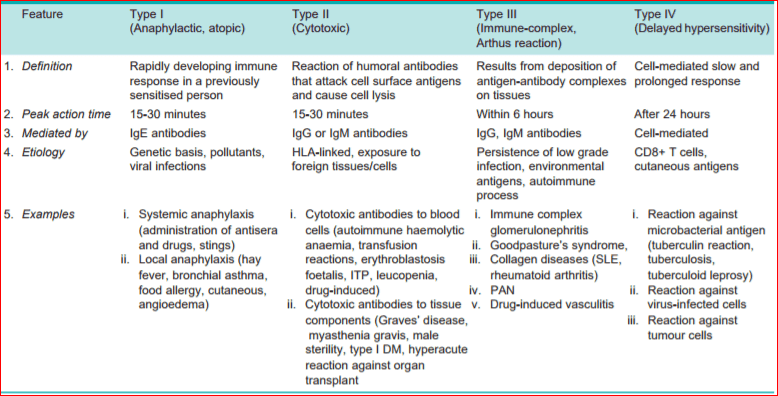
Hypersensitivity reaction
Comparison of hypersensitivity types
|
Type V hypersensitivity reaction
- This is an additional type that is sometimes (often in the UK) used as a distinction from Type 2.
- Instead of binding to cell surfaces, the antibodies recognise and bind to the cell surface receptors.
| A |
Type 1 |
|
| B |
Type 2 |
|
| C |
Type 3 |
|
| D |
Type 4 |
Ans. is ‘b’ i.e., Type 2
- Type V hypersensitivity reactions were additionally added to the scheme originally described by Coombs and Gell. Contrary to type IV and in agreement with types I, 11 and III respectively, they are mediated by antibodies too.
The type V reactions are sometimes considered as a subtype of the type II hypersensitivity.
- As its mechanisms do not destroy target cells, they are responsible for induction of organ/tissue dysfunctions only most of authors prefer it to be and independent, the 5′ type of hypersensitivity reactions
A patient was on treatment with penicillin. He developed pallor but there was no shortness of breath, urticaria or wheezing. On investigation, antibodies against penicillin were found in his blood. What is the type of hypersensitivity reaction that most likely occurred in this patient?
| A | Type I hypersensitivity | |
| B |
Type II hypersensitivity |
|
| C |
Type III hypersensitivity |
|
| D |
Type IV hypersensitivity |
Ans. B. Type II hypersensitivity
An example of type II hypersensitivity is the reaction to penicillin wherein the drug can bind to red blood cells, causing them to be recognized as different; B cell proliferation will take place and antibodies to the drug are produced.
A hypersensitivity reaction is shown in the image.From the following options,which option is an example of this type of reaction?
| A |
SLE |
|
| B |
Erythroblastosis Foetalis |
|
| C |
Tuberculoid leprosy |
|
| D |
Bronchial Asthma |
Ans:B.)Erythroblastosis Foetalis
Type II hypersensitivity reaction is shown in the image.
According to WHO, membranous glomerulonephritis seen in SLE, is ‑
| A |
Class II |
|
| B |
Class III |
|
| C |
Class IV |
|
| D |
Class V |
Ans. is ‘d’ i.e., Class V
