
ULNAR NERVE INJURY
* Ulnar nerve injury may be high or low.
1) High ulnar nerve palsy
* High ulnar nerve palsy is caused by injury proximal to the elbow.
* All the muscles supplied by ulnar nerve are paralysed & there is atrophy of hypothenar eminence.
* Sensory loss in the medial 1/3rd of the palm & medial one & half of fingers.
2) Low ulnar nerve palsy
* Injury in distal-third of forearm or at wrist.
* Flexor digitorum profundus & flexor carpi ulnaris are spared.
* Muscles of hand are paralysed:
i) Hypothenar muscles:
* Palmar brevis
* Abductor digiti minimi
* Flexor digiti minimi
* Opponens digit minimi
ii) Adductor pollicis
iii) All interossei (Palmar & Dorsal) & medial two lumbricals (3rd & 4th).
* Sensory loss is same as in high ulnar nerve palsy.
* The patient is asked to palmar flex the wrist against gravity.
* In doing so, the hand deviates towards the radial side.
* The tendon of flexor caroi ulnaris just above the pisiform, does not stand out.
* On performing the same test against resistance, the tendon cannot be felt.
* This is for dorsal interossei (abductors) of the middle finger.
* With the hand kept flat on a table palmar surface down, the patient is asked to move his middle finger sideways.
* This is for palmar interossei (adductors) of the fingers.
* In this test, the examiner inserts a card b/w two extended fingers & the patient is ssked to hold it as tightly as possible while the examiner tries to pull the card out.
* The power of adductors can thus be judged.
* In case of weak palmar interossei, it is easy to pull out the card.
* First dorsal interosseous muscle can be separately examinated by asking the patient to abduct the index finger against resistance.

3) The lumbricals:
* These are mainly responsible for flexion at the metacarpo-phalangeal joints but their isolated action cannot be tested.
* The patient is asked to grasp a book b/w the thumb & index finger.
* Normally, a person will grasp the book firmly with thumb extended, taking full advantage of the adductor pollicis & the first dorsal interosseous muscles.
* If the ulnar nerve is injured the adductor policis will be paralysed & the patient will hold the book by using the flexor pollicis longus (supplied by median nerve) in place of the inter-phalangeal joint of the thumb.
* This is because more pronounced if the examiner tries to pull the book out while the patient tries to hold it.
* This sign is known as ‘Froment’s sign’ or the ‘book test’.

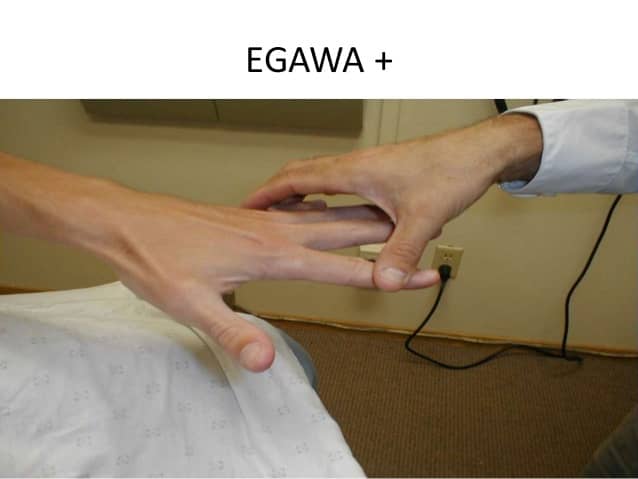
* Inability to adduct the small finger in against the ring finger due to weakness of palmar interosseous muscles.

Exam Important
* Tardy ulnar nerve palsy is seen in Lateral condyle # humerus.
* Knuckle bender splint is used for Ulnar Nerve Palsy.
* Claw hand is caused by lesion involving Ulnar nerve.
* Cubital tunnel syndrome involves Ulnar nerve.
* In Hansen’s disease, the nerve commonly affected at elbow is Ulnar nerve.
* Most common nerve injured in fracture of medial epicondyle of humerus is Ulnar nerve.
* Inability to adduct the thumb is due to the injury of Ulnar nerve.
* Froment test is positive in lesion of Ulnar nerve.
Click Here to Start Quiz

